Four rooms, hired singly or together
Venue Hire in Norwich: The Halls for Weddings, Conferences and Events
What each of the four spaces is good for, how they combine, and the practical constraints that shape any booking in a listed medieval building.
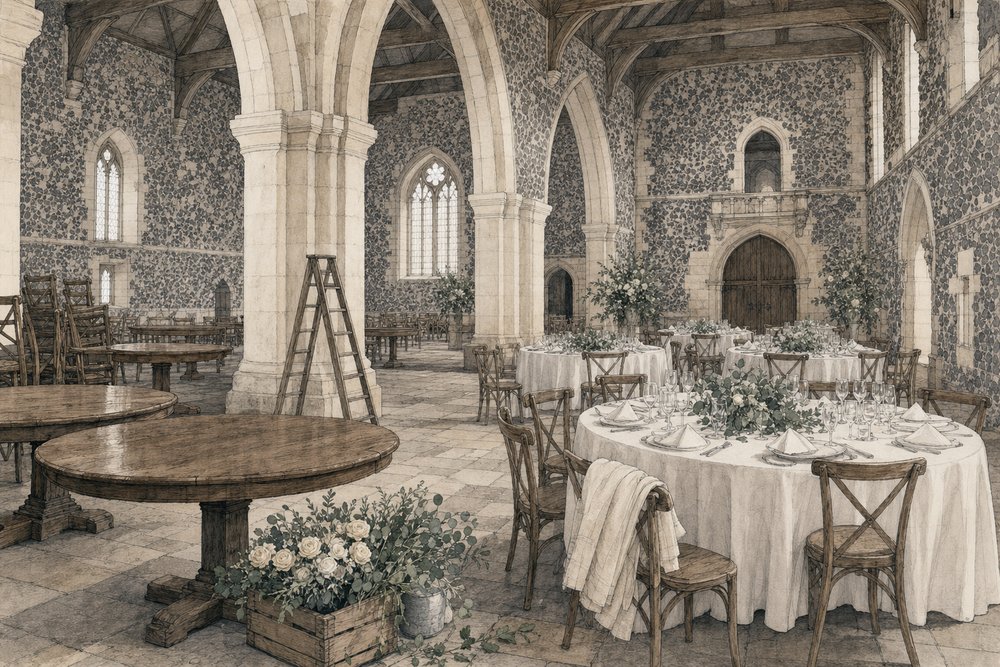
Among the wedding venues Norwich can offer, few give a choice like this one, and the venue hire Norwich supports at this scale is narrower still. The complex has four genuinely different rooms inside one historic envelope, bookable separately for modest events or together for large ones, and the character of each is set by what it originally was.
Venue hire in Norwich: the four spaces
St Andrews Hall is the former nave and the largest room in the complex, taking something over 750 seated. It is the room for concerts, ceremonies, banquets, degree congregations and any trade event that needs floor area, and its scale is the reason most people know the building at all.
Blackfriars Hall is the former chancel beyond the crossing. Smaller at around 250 seated, oak-panelled and lit by tall windows, it suits conferences, lectures, smaller dinners and receptions that would rattle around in the nave. It also works as the quieter half of a two-room event. Two hundred and fifty people still hear a speaker without reinforcement.
The Cloisters is the surviving cloister walk, and it has been the natural home for fairs and markets for as long as anyone has kept records. As a hireable space it does duty for drinks receptions, exhibitor stands and registration, usually in support of whatever is happening in the halls themselves.
The Crypt is the undercroft beneath the east end and the smallest room on the site. It takes meetings, workshops, tastings and intimate dinners, and it is the space people book when they want the age of the building to be unmistakable. Nothing else in the complex makes the age of the place so immediately obvious.
Matching a wedding or conference to the room
Anyone weighing the wedding venues Norwich lists arrives with a shape in mind, and most enquiries fall into a handful of recognisable ones. The section pages go into each of them: weddings, conferences and business meetings, dining events, music and performance, trade and collectors’ fairs and small room hire. Each sets out which room suits the format.
The useful question is rarely “how many people” on its own. A hundred guests seated for dinner, a hundred standing at a reception and a hundred in rows for a lecture need three quite different rooms, and the mismatch between headcount and layout is the commonest reason an enquiry gets reworked. The capacity notes set the figures out by layout.
What hiring the halls in a listed building asks of you
Hiring a fifteenth-century friary church is not like hiring a conference centre, and the differences are worth knowing in advance. Nothing can be fixed to historic masonry. Rigging points are limited and pre-agreed. Floor loadings matter for heavy exhibits. Open flame is controlled. Power and data runs have to follow routes that do not compromise the fabric.
None of that prevents ambitious events — the building has handled orchestras, banquets and trade fairs for centuries — but it does mean the production conversation happens earlier than it would elsewhere. Suppliers who have not worked in heritage venues should be told what they are walking into before they load a van.
Practicalities around a venue hire booking
Venue hire in Norwich means a city-centre site, and this one sits beside a pedestrianised quarter, so loading, parking and delivery windows need planning; the visiting page covers the approaches and where vehicles can actually get to. Catering, licensing and staffing are arranged through the venue rather than assembled independently by the hirer from separate suppliers.
The venue hire Norwich offers ranges widely, and for smaller gatherings the halls are not always the right answer; anyone weighing options across the wider area will find Church halls for hire a useful comparison. For anything that wants the room itself to be part of the occasion, this building is hard to substitute.
Plans are indicative and drawn to the room's proportions. Staging, catering and licensing move the working figure, which is set with the venue when a booking is made.
More in this section
Common questions
How do bookings for the halls actually work?
Hire is arranged directly with Norwich City Council, which owns and operates the complex as The Halls. The council handles availability, quotations, licensing and the technical arrangements, and publishes its own current terms, so enquiries go to the venue team, not through any intermediary. The council publishes its own terms, so quoted figures from elsewhere are worth treating with caution.
Can more than one room be hired at the same time?
Yes, and many larger events do exactly that. A common pattern is a ceremony or performance in one hall, a drinks reception in the cloister walk and dining in the other hall, with guests moving between them as the evening progresses rather than everything happening in a single room from start to finish.
Is there a resident caterer, or can an outside one be brought in?
Catering arrangements are set by the venue, not by the hirer alone, and there are practical limits on what a listed building with no purpose-built kitchen can accommodate. Anyone planning a dinner should settle the catering question early, because service routes and plating space constrain the layout more than most people expect.
What are the constraints of holding an event in a listed building?
Fixings, rigging, open flame, heavy loads on historic floors and anything attached to masonry are all restricted. None of it prevents ambitious events, but staging plans need approval before anything is built, and suppliers unfamiliar with heritage venues should be briefed before they arrive. A quote given without the restrictions is a quote that will have to be redone.
Are the halls licensed for civil weddings?
Both main halls have been licensed for civil ceremonies, which is why the complex appears on wedding-venue listings across Norfolk. Licensing conditions are reviewed periodically, so couples should confirm the current position for the room and date they want before committing to anything else. A licence is held room by room, not across the complex as a whole.
Is the building accessible for disabled guests and exhibitors?
Access was one of the priorities of the recent restoration, and step-free routes, improved facilities and better circulation were part of that work. Because the fabric is medieval, some routes remain indirect, so specific access needs are best raised with the venue team at the enquiry stage. Arrangements that are straightforward with notice become difficult once an event is running.