The collectors' trade
The Antiques and Collectors' Fair in Norwich at The Halls
The oldest continuously commercial use of the building, and the reason a great many people in Norwich know the cloister walk at all.
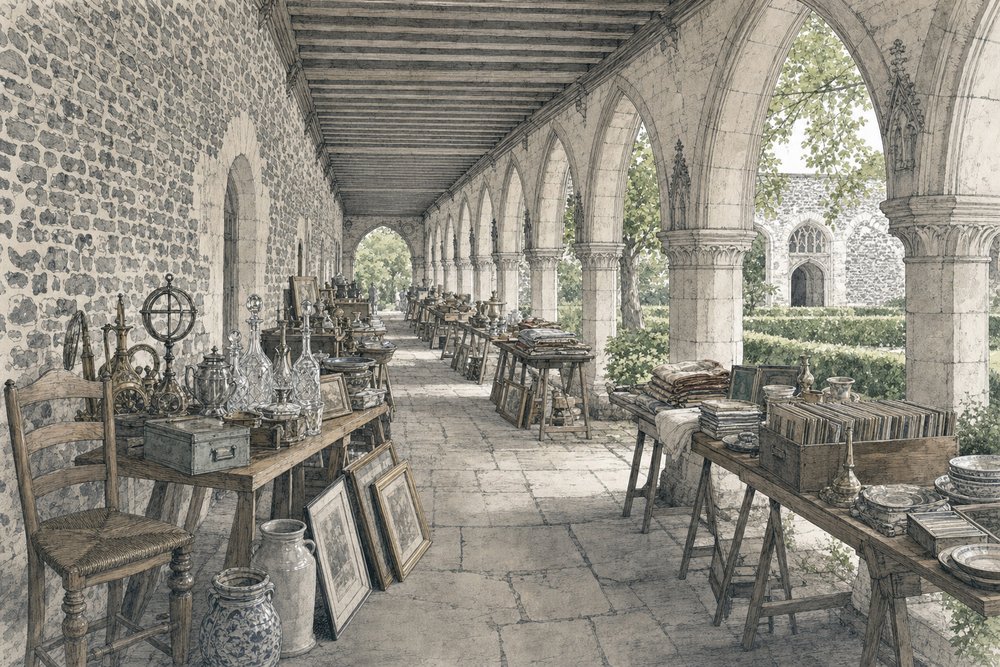
Of all the things this building does, the one with the longest unbroken commercial record is trade. Markets and fairs have run here for most of the time the city has owned it, and the antiques and collectors’ fair is the direct modern descendant of that tradition. Trade, in other words, outlasted both the friars and the concerts.
Why the cloister walk suits it
The cloister walk was built as circulation space for a religious community: a wide, covered, straight run with openings along one side, generous enough to read and teach in. Six hundred years later that description also happens to specify an excellent market aisle. Nothing about it was designed for commerce, and yet almost nothing could suit commerce better.
Stalls line naturally along it, visitors move in one direction without the crossing and doubling back that a grid layout produces, and the whole thing is under cover without being enclosed in the way a modern hall is. Larger fairs extend into the halls when they need the stand count, but the walk is the characteristic space.
What the trade covers
The range is what anyone who has worked a general antiques market would expect: furniture, ceramics, glass, silver, jewellery, prints, books, coins, militaria, textiles and a great deal of assorted bric-a-brac. Quality varies stall by stall, which is the nature of a general fair and not a specialist one, and specialist dealers work the same aisles as general clearers.
Related trades have used the same floors as separate events. Record fairs in particular built a following here, and book fairs and craft markets have taken the building at various points. For a long period the halls were simply where a Norwich buyer with an afternoon free went to browse rather than to shop for anything in particular.
Visiting a fair here
Fairs of this kind commonly charge a modest admission, and many operate an early-trade session at a higher rate before general opening — a convention that exists because dealers buy from each other before the public arrives. Arrangements are the fair organiser’s to set, and they set them. Visitors intending to buy seriously should budget for the earlier slot.
Practical advice is the same as for any event on the site. The approaches, parking and step-free routes are covered on the visiting page, and the central location means public transport is generally easier than driving. Arriving early matters more at a fair than at a concert, because the best material moves first.
Selling at a fair
Stallholder bookings go to the fair organiser, not to the venue. Anyone considering taking a stand should understand that a listed medieval building imposes real constraints: nothing fixes to masonry, tall or heavy display units need checking in advance, and load-in is governed by the restricted vehicle access that applies across most of the city centre.
Those constraints are set out from the organiser’s side in the trade fair notes. They are entirely workable — fairs have run here for generations — but they reward planning instead of improvisation on the morning. A fair that plans its load-in around the Plain’s restrictions rarely loses time on the day.
Checking before you go
Market schedules change with organisers, seasons and the rest of the venue’s programme, and the pattern people remember is not always the pattern currently running. The venue’s own listing, linked from the events guide, is the source worth trusting for a specific date, and checking it saves a wasted journey across a city that is awkward to park in.
Common questions
When is the antiques fair held?
The collectors' trade has used the building on a recurring basis for a very long time, but market schedules change with organisers and seasons. The venue's own current listing is the reliable source for dates, and a pattern remembered from a few years ago is not a safe guide to the present one.
Where in the building does the fair take place?
The cloister walk is the space most closely associated with it. A covered straight run with openings along one side is close to the ideal shape for a line of stalls, and larger fairs extend into the halls themselves when the stand count requires it. Its proportions have suited stallholders for far longer than any current organiser has been involved.
What is sold at the fair?
The usual range of a general antiques and collectables market: furniture, ceramics, glass, silver, jewellery, prints, books, coins, militaria, textiles and assorted bric-a-brac. Record fairs and book fairs have run in the same spaces as separate events with their own followings. Quality varies from stall to stall, which is the nature of a general fair rather than a specialist one.
Is there an admission charge?
Fairs of this kind commonly charge a modest entry, sometimes with early-trade admission at a higher rate before general opening. Because arrangements are set by whoever organises a given fair, not by the building, the current position comes from the event listing. The early session exists because dealers buy from one another before the public arrives.
Can I sell at the fair?
Stallholder arrangements are made with the fair organiser, not with the venue directly. Anyone considering it should note the practical constraints of a listed building, since stand construction, fixings and load-in are all more restricted here than in a purpose-built market hall. Briefing a supplier before they quote avoids almost all of the difficulty on the day itself.
How long has the fair been running here?
The association between this building and the collectors' trade goes back generations, and fairs of one sort or another have used the site for far longer than any single organiser's involvement. That continuity is part of why the venue still appears in fair listings across the region, with individual organisers coming and going while the trade carried on.