Performance history
St Andrews Hall Norwich Events: A History of Concerts, Gigs and Live Music
For more than a century the nave has been Norwich's main concert room. This is what can be verified about who played it, drawn from the archives that keep the records.
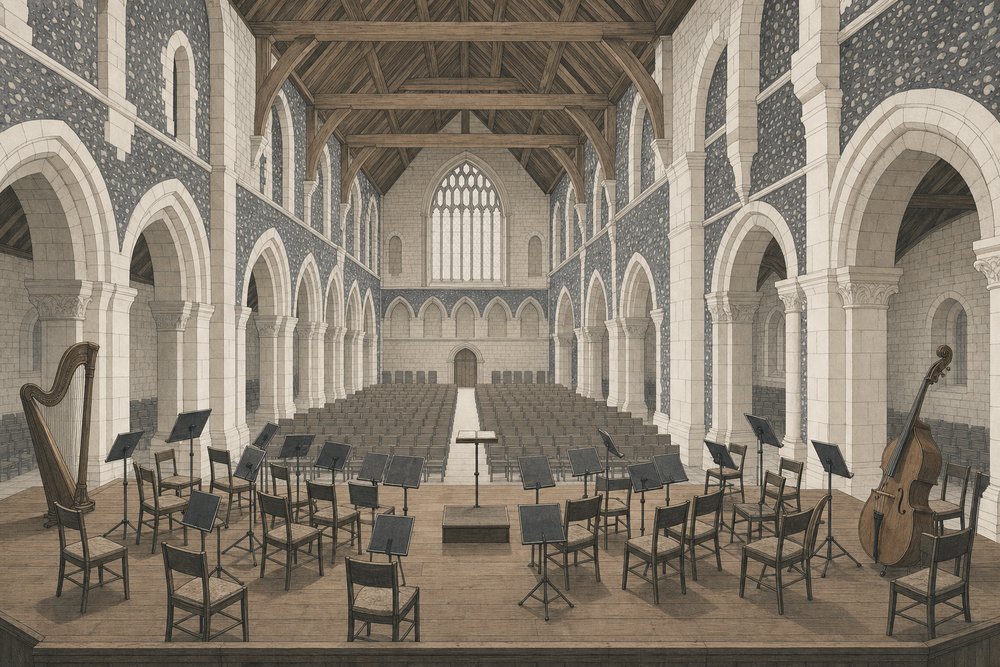
Searches for St Andrews Hall Norwich events end up here for a simple reason: the city has never had an abundance of large rooms. For most of the period in which concert-going became a public habit, this nave was the biggest indoor space in Norwich with anything like the right acoustic, which made it the default room for visiting musicians.
Live music at St Andrews Hall: the classical foundation
Live music in the building is longest and best documented on the classical side. The Norwich Philharmonic Society has been performing in the hall since the Victorian period and still treats it as home, giving the room an unbroken orchestral tradition of a kind few provincial venues can claim, documented in a way touring bands rarely are.
The Norfolk and Norwich Festival has used the hall throughout its modern existence, and touring orchestras have followed the festival in. The Philharmonia appeared here for the festival in May 2014 and again for its Lutosławski centenary programme, while the Bournemouth Symphony Orchestra and Britten Sinfonia have both listed the hall among their regular East Anglian dates.
Smaller ensembles have used it just as steadily. The Brook Street Band’s concert archive records appearances from 2001 onward, and the Chamber Orchestra of East Anglia gave the Peter Aston Memorial Concert here in 2014. The University of East Anglia’s music centre programmed the room as well, including a concert on 21 April 2015.
Concerts, gigs and the rock and pop record
The live music record on the other side is less tidily kept, because nobody was maintaining an official register of touring bands. What survives is held by fan archives and discographical databases, and it is surprisingly rich once you go looking. Nobody in 1981 expected a Tuesday night in Norwich to need documenting, and so almost nobody documented it.
The Cure played the hall on 12 May 1981, a date logged in both the German and Czech Cure concert archives. Tangerine Dream brought their 1975 cathedral tour here, a run of English ecclesiastical buildings chosen for exactly the acoustic this room has. Budgie appeared on 26 November 1982, recorded in the Last.fm event listings.
Rick Wakeman has the densest association of anyone. His various official and fan-run sites list the hall repeatedly across four decades of touring, including the solo evenings he took around smaller British rooms in 2011. Folk and roots acts appear too: the Mangledwurzels played the Norwich Real Cider and Perry Festival here in June 2007.
Why the archives point to Norwich
Concerts at St Andrews Hall are scattered across a dozen private archives. Anyone reconstructing a band’s touring history needs to know which room in a given city they played, and for Norwich the answer is very often this one. That is why so many databases, fan sites and discographies carry the hall’s name at all.
The consequence is that the record is distributed and not centralised. A single night might be documented in a fan’s tour archive, a local newspaper review, a ticket stub photographed for a collectors’ database and nowhere else. The individual pages in this section each rebuild one night from whatever sources can be found for it.
Events at St Andrews Hall Norwich: the room as a place to play
Concerts at St Andrews Hall have a particular character, and musicians describe the space in the same terms: tall, long, stone, unforgiving of anything under-rehearsed. The arch-braced hammerbeam roof gives a long decay that flatters massed voices and muddies fast amplified material whenever the engineer at the desk does not respect it.
Performers describe St Andrews Hall Norwich events the same way across five decades, and sightlines are the other reason. Because the room was built as a preaching box, not a church of chapels and screens, almost every seat has an uninterrupted view of the platform. The capacity notes set out how the layouts change that.
More in this section
Common questions
Is St Andrews Hall still used for concerts?
Yes. Live performance remains one of the building's primary functions, and the city council's programme continues to list concerts alongside talks, fairs and community events. The recent restoration included upgrades to the technical infrastructure that a working music venue needs. A room programmed twelve months ahead is a working venue, not one merely kept standing.
What sort of music does the hall suit?
Its acoustic was made for an unamplified voice carrying to the back of a preaching church, which suits choral and orchestral work particularly well. Amplified music works too and always has, but the room rewards anything that can fill a tall stone volume instead of fighting it, and punishes anything that cannot.
Which famous bands have played St Andrews Hall?
The verifiable list includes The Cure in May 1981, Tangerine Dream on their 1975 cathedral tour, Budgie in November 1982 and Rick Wakeman on several occasions across four decades. Touring orchestras including the Philharmonia, the Bournemouth Symphony and Britten Sinfonia have also appeared here. Each rests on an archive kept by enthusiasts, none of it by the venue.
Was the hall ever a ticket office for other venues?
For a period it acted as a booking point for concerts elsewhere in the city, including events at the University of East Anglia. That arrangement has long since ended, and tickets for UEA performances are now handled by the university's own box office. The arrangement left a long tail of searches that still reach this building by mistake.
How many people does the concert layout hold?
Seated concert layouts in the nave run to something over 750, with standing configurations taking more. The exact figure depends on staging depth, the seating plan in use and the licensing conditions that apply to a given event, so promoters should treat it as a per-event figure and not a published capacity.
Where can the full performance record be found?
There is no single official register. What exists is scattered across band archives, fan-maintained tour databases, orchestral programme listings and local press, and the pages linked from here reconstruct individual nights from those sources rather than from one authority. That distributed record is fragile, but it is the only one that exists.