A heritage grouping
Norwich 12: The City's Twelve Heritage Buildings and The Halls
The city's principal historic buildings, presented together, and why a friary church belongs in that company.
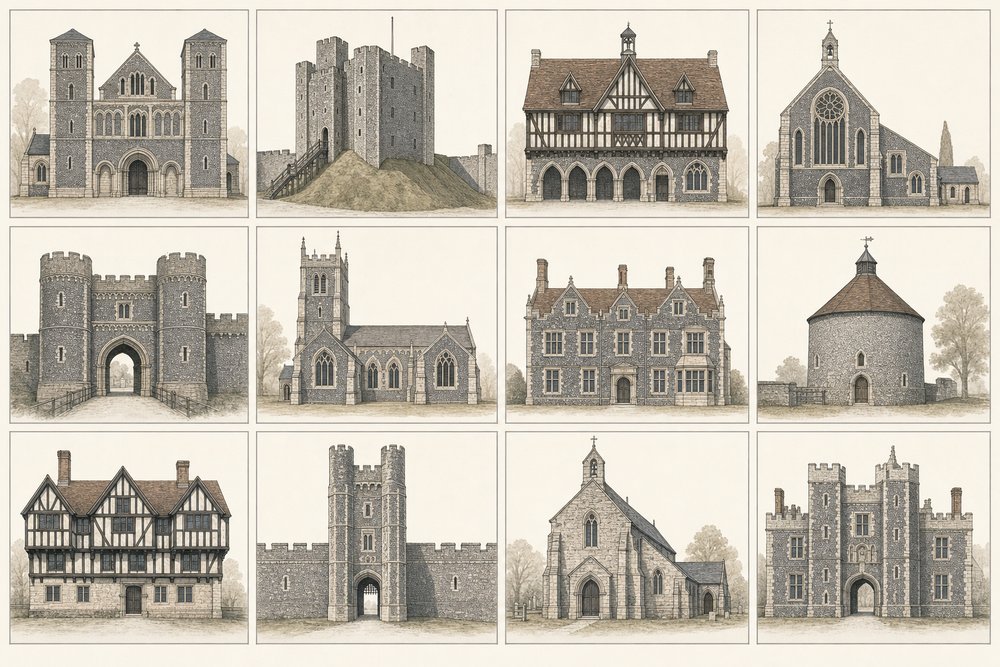
Norwich 12 is a grouping of the city’s most significant heritage buildings, presented as a single collection, not as separate attractions. The friary complex at St Andrews Plain is among them, and understanding why says something useful about what this building actually is. Survival alone would not earn the place; the afterlife is what does.
The idea behind the grouping
Cities with a great deal of surviving historic fabric face a presentational problem: individually, each building is one more old structure, but together they document how a place grew. The grouping addresses that by treating the principal buildings as a set spanning roughly nine centuries. Presented together they carry an argument that no single building makes on its own.
The range is deliberately wide. It runs from the Norman period through the medieval and early modern city to the twentieth century, which makes the point that Norwich kept building and not peaking in one era and then preserving the results. A city that stopped building in 1400 would have a very different list.
Where the halls fit
The friary complex earns its place on two separate grounds, and the second is the more interesting. The first is straightforward: it is the most complete surviving friary in England, which is a national rather than a local distinction, and the history of the site sets out how that survival happened.
The second is its afterlife. Most heritage buildings are valued for what they were. This one has spent nearly five centuries being something else — a common hall, an assize court, a corn exchange, a concert room, a market floor — and that continuous adaptation is itself a record of the city’s changing needs.
A working building and not a monument
That distinction matters for visitors. Some of the twelve are museums or places of worship with regular opening hours and an admission desk. The halls are not. They are an operating venue, and access normally comes through attending whatever is on, not through a ticket to look around. Turning up expecting a ticket desk is the commonest disappointment here.
Heritage open days and guided tours do appear in the programme and are the reliable way to see the building for its own sake. The events guide covers how the calendar works and where current listings live. Those days are the reliable route in for anyone whose interest is the building itself.
Seeing several in a visit
The compact centre helps. Most of the buildings sit within a comfortable walk of one another, and anyone intending to see several in a day will find the geography cooperative. The halls stand on St Andrews Plain, close to Elm Hill, on a natural route between the castle and the cathedral.
Practical detail for reaching this particular building — approaches, parking, step-free routes — is on the visiting page. Approaches, parking, step-free routes and the position of the entrances on each street frontage are all gathered there, and they matter more here than at most heritage sites because the Plain itself has almost no parking.
What the grouping does not do
It is worth being clear that a heritage grouping is a framing device, not a legal status or a guarantee of access. It exists to help people understand a city’s fabric as a whole, and its effect is on how the buildings are presented, not on how they are used.
For this building, the day-to-day reality remains that of a venue: concerts, fairs, conferences and weddings in rooms that happen to be six hundred years old. The civic portrait collection housed here is a reminder that its institutional life has run alongside its architectural one all along, and that a heritage grouping changes the presentation and not the use.
Common questions
What is Norwich 12?
A grouping of the city's most significant heritage buildings, presented together as a single collection spanning the Norman period to the twentieth century. The idea behind it is that the buildings tell a continuous story of the city far more effectively as a set than any one of them manages alone.
Which buildings are included?
The set brings together the city's principal landmarks across nine centuries, including both cathedrals, the castle, the guildhall, the assembly house, the city hall and the friary complex at St Andrews Plain. The selection is deliberately broad in period instead of concentrated in the medieval. A twentieth-century city hall sits in the same list as a Norman keep.
Why is St Andrews Hall included?
Because it is the most complete surviving friary complex in England and because its post-medieval civic use is itself part of the city's story. A building that has served as common hall, concert room and market floor continuously since 1538 documents the ordinary history of Norwich as directly as any cathedral does.
Can all twelve be visited?
Access varies considerably. Some are museums or places of worship with regular opening, while others are working buildings whose interiors are seen through events or open days. The halls fall firmly into the second group, being an operating venue instead of a visitor attraction. Opening hours belong to museums; this one opens when something is happening in it.
Is there a walking route between them?
The buildings sit within a compact city centre, and most are within a comfortable walk of one another. Heritage trails linking them have been promoted at various times, and anyone planning to see several in a day will find the geography helpful. Norwich rewards walking more than almost any English city of its size.
What period do the buildings span?
Roughly nine hundred years, from the Norman cathedral and castle through medieval merchant and civic buildings to the twentieth-century city hall. That span is the point of the grouping: it shows a city that kept building instead of one that peaked in a single era. Few English cities can show nine centuries of building without a gap in the sequence.