Concerts and recitals
Music Venue Hire in Norwich: Staging Concerts at St Andrews Hall
What promoters and ensembles need to know about putting music into a fifteenth-century preaching church.
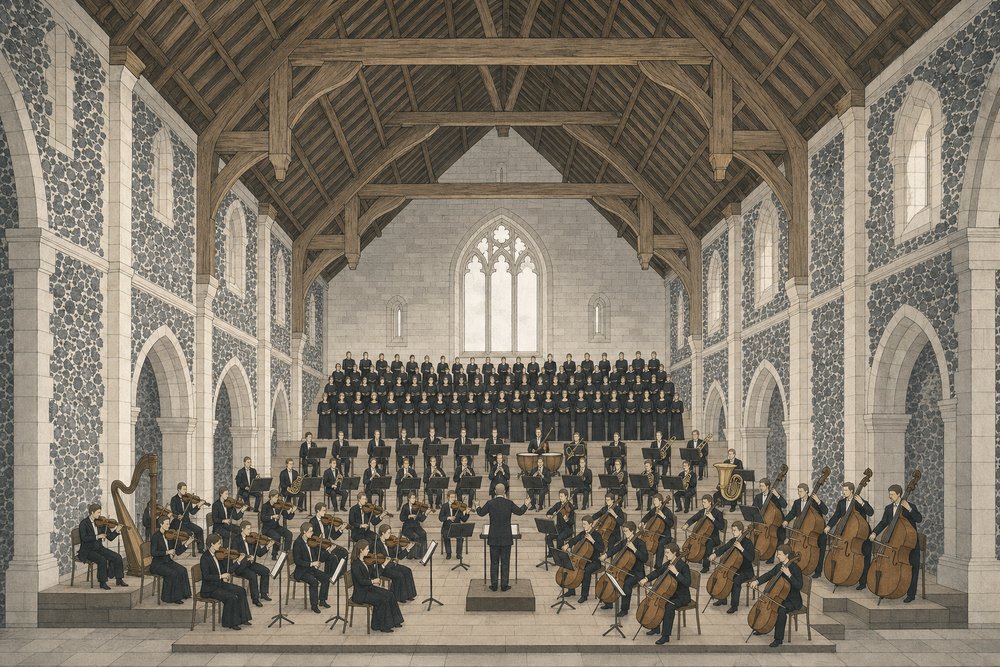
Music has been the building’s defining modern use, and the reason is architectural and not historical. The Dominicans built a room to carry a speaking voice to several hundred people without amplification, and that is very nearly the specification for a concert hall. That is very nearly the specification for a concert hall, arrived at four centuries early.
The acoustic
The nave is tall, long, stone-walled and roofed in timber, which produces a generous decay that flatters massed sound. Choirs, organs and orchestras get something from the room that a modern concert hall has to simulate electronically. It is not a neutral space, and it was never built to be one.
The corollary is that fast, dense, amplified material needs handling. Engineers who have worked reverberant rooms know the drill — control the low end, keep the source tight, resist the urge to push level — and touring crews have been doing exactly that here since the 1970s. The performance history records how many of them managed it.
For chamber programmes the calculation is different. Blackfriars Hall at around 250 supports a single voice or instrument without the long tail, and for a recital it is frequently the better room. The crypt takes very small performances where proximity is the point. Proximity, not volume, is what a recital audience is buying.
Audience and layout
Seated concert layouts in the nave run to something over 750, with standing configurations taking more. The figure moves with staging depth, the seating plan in use and the licensing conditions applying to a given event, so promoters should treat it as a per-event number instead of a published capacity.
Sightlines are the room’s quiet advantage. Because the Dominicans built without screens or chapels interrupting the volume, nearly every seat sees the platform, which is more than can be said for many purpose-built halls of comparable age. The capacity notes set out the layout variations. Clear sightlines from nearly every seat are rare in any room of this age.
Production in a listed building
The constraints will be familiar to anyone who tours heritage venues. Rigging points are limited and agreed well in advance. Nothing fixes to masonry. Floor loadings matter for heavy staging and backline. Power and cable routes follow paths that protect the fabric. Nothing is fixed to the masonry, so every run is planned before it is pulled.
Sending requirements ahead is therefore not a formality here. A standard rig designed around a modern venue’s roof steel may simply not be deployable, and the time to discover that is at the advance stage, not on the load-in. The general position for the complex is in the hire guide.
Load-in and the city centre
The site sits in central Norwich with limited vehicle access to the Plain itself, which makes load-in a planning matter for anything larger than a recital. Access windows, vehicle sizes and the route to the doors are agreed with the venue, and the visiting page covers the approaches for anyone who needs to get a van close.
Why ensembles keep coming back
The building has held the Norwich Philharmonic Society since the Victorian period, carried the Norfolk and Norwich Festival through its modern life, and taken visiting orchestras from the Philharmonia to the Bournemouth Symphony. That continuity is the strongest recommendation the room has, because musicians who have played it once tend to come back.
Common questions
What is the acoustic of St Andrews Hall like?
Long-decaying and generous, because a preaching church was built to carry an unamplified voice to the back of a tall stone room. Choral and orchestral programmes benefit from it directly. Amplified material works but needs an engineer who has handled reverberant spaces, where controlling the low end is most of the job.
How large an audience can a concert take?
Seated concert layouts in the nave run to something over 750, with standing configurations taking more. The working figure depends on the staging depth, the seating plan and the licensing conditions for the event, so it is set per booking and not published as a single number. Staging depth, seating plan and licence together decide what the room actually holds.
Is there a resident piano or organ?
Instrument provision is a matter for the venue and varies, so it should be confirmed instead of assumed. Ensembles requiring a specific instrument, tuning or stage piano generally arrange it as part of the booking, which is standard practice for a multi-purpose hall of this kind and not a sign of anything missing.
What are the rigging and staging limits?
Rigging points are limited and agreed in advance, and nothing may be fixed to the historic masonry. Staging weight on the floor needs checking in advance too. Touring productions with a standard rig should send their requirements ahead, because what is possible here is set by the fabric and not by the truss.
Does the hall suit amplified rock and pop?
It has done for fifty years. The Cure, Tangerine Dream, Budgie and many others have played it, and the record shows the room handles amplified music perfectly well. The consistent theme in accounts of those nights is that the engineer has to work with the reverberation rather than against it.
Can the smaller rooms be used for recitals?
Blackfriars Hall is a genuinely good recital room at around 250, with an acoustic that supports a single instrument or voice without the long tail of the nave. For chamber programmes it is frequently the better choice, and the crypt takes very small performances. A recital carried by proximity loses more than it gains in a larger room.