Stands, exhibitions, markets
Trade Fairs in Norwich: Exhibition and Collectors' Fair Space
The halls have been trading floors for centuries. What an organiser needs to know about running a fair in a listed building.
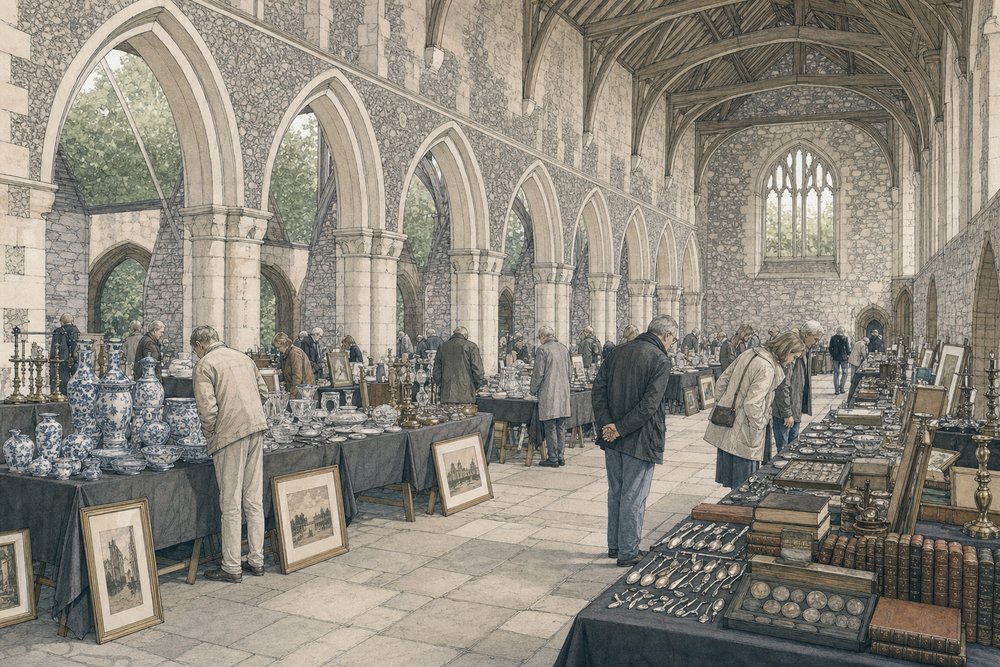
Trading in this building is not a modern innovation. Markets, fairs and exchanges have run here for most of the time the city has owned it, and the collectors’ trade in particular has a continuous association with the site that goes back generations. Dealers still name the venue in their own advertising to collectors.
The floors available
St Andrews Hall gives the largest clear area, and its aisles have taken stand layouts for a very long time. The arcades divide the space in a way that suits rows running with the length of the room, and the height means a full floor of stands never feels oppressive.
The cloister walk is the other natural trading space, and arguably the more characteristic one. A covered straight run with openings along a side is very close to the ideal shape for a line of tables, which is why the antiques and collectors’ fair has been so closely bound to it.
Blackfriars Hall takes a specialist section or an overflow, and larger fairs use all three so that visitors work a circuit and not a single room. Splitting a fair across the rooms gives visitors a natural circuit and gives specialist dealers a section of their own, which most general markets cannot offer at all.
Stand construction in a listed building
This is where fairs most often run into trouble, and the rules are worth putting in the exhibitor pack rather than leaving to discovery. Nothing may be fixed to historic masonry. Tall structures need checking. Heavy units have to be assessed against floor loadings before they arrive, and learning any of that on the morning is expensive.
A modular stand built for a purpose-built exhibition hall assumes a flat grid, free fixing and unlimited height. None of those assumptions hold here. Organisers who send exhibitors this venue’s own conditions with the booking form have far fewer problems on the morning, because the exhibitor can re-plan in the workshop instead of in the doorway.
Load-in and logistics
The site is central, which is excellent for visitor numbers and awkward for vans. Vehicle access to the Plain is limited, so access windows and vehicle sizes are agreed with the venue, and fairs with many exhibitors normally stagger their arrivals across the morning instead of opening the doors to everyone at once.
Power follows the same principle as everything else: it is available, but routed to protect the fabric, so requirements go in with the stand booking rather than being improvised on site. The visiting page covers the approaches and the nearest parking for both exhibitors and visitors. Power arrives where the fabric allows it, which is rarely where a plan assumed.
The collectors’ trade
The building’s association with second-hand and collectors’ trading is the strongest of its commercial connections. Antiques and collectors’ fairs, record fairs, book fairs and craft markets have all worked these floors, and for a long period the halls were simply where a Norwich buyer went to browse. Dealers still cite the venue by name when advertising to collectors.
That history matters commercially as well as sentimentally. Fairs benefit from a venue people already know how to find and already associate with the trade, and this one has had that recognition for decades. The events guide covers what the building carries more generally. This one has had that recognition for decades, and it still shows in the footfall.
Planning a fair here
The useful sequence is to fix the circuit first, then the stand count. Because the rooms are connected but distinct, visitor flow is a design decision and not an emergent property, and fairs that think about where people enter, how they move and where they end up consistently do better than those that simply fill the available floor.
Everything else follows the general position for the complex set out in the hire guide: hire runs through Norwich City Council, catering is arranged by the venue, and production planning starts earlier than it would in a modern hall. A modern hall absorbs a late change; a listed building makes you plan around it.
Common questions
How many stands can the halls take?
It depends on the floor area each stand takes, not on a headline number. The nave gives the largest clear floor and its aisles have carried trade layouts for generations, while the cloister walk suits a straight run of tables. Layouts are planned against the arcades and piers, not on an open grid.
Are there restrictions on stand construction?
Yes, and they catch exhibitors out most often. Nothing fixes to historic masonry, tall structures need checking, and heavy units have to be assessed against floor loadings. A modular stand designed for a purpose-built exhibition hall may not be deployable here exactly as supplied. Height, weight and fixing are the three specifications to check before the van is loaded.
What is load-in like for exhibitors?
Constrained, because the site is in a city centre with limited vehicle access to the Plain itself. Access windows and vehicle sizes are agreed with the venue in advance, and fairs with many exhibitors normally run a staggered arrival across the morning, because forty vans at one gate is a morning lost before anything is unpacked.
Is there power available at stands?
Power is available but routed in ways that protect the fabric, so it is arranged through the venue instead of run ad hoc by exhibitors. Requirements should go in with the stand booking, because cable routes in a listed building arrive where the fabric permits and not where a plan assumed.
What kinds of fair have been held here?
Antiques and collectors' fairs above all, alongside record fairs, craft markets, book fairs and general bric-a-brac trading. The building has a long and continuous association with the second-hand and collectors' trade, which is why it still appears in fair listings across the region. The building's association with the second-hand trade is the strongest of its commercial connections.
Can a fair use more than one room?
Larger fairs routinely do. A common arrangement puts the main floor in the nave, overflow or a specialist section in Blackfriars Hall and a straight run of tables along the cloister walk, which gives visitors a circuit to work rather than a single room, and a circuit gets every stand seen.