St Andrews Plain · Norwich NR3 1AU
St Andrews Hall Norwich and Blackfriars Hall: The Halls Venue Guide
The most complete surviving friary complex in England, built for the Dominicans in the fifteenth century and in civic use since 1538.
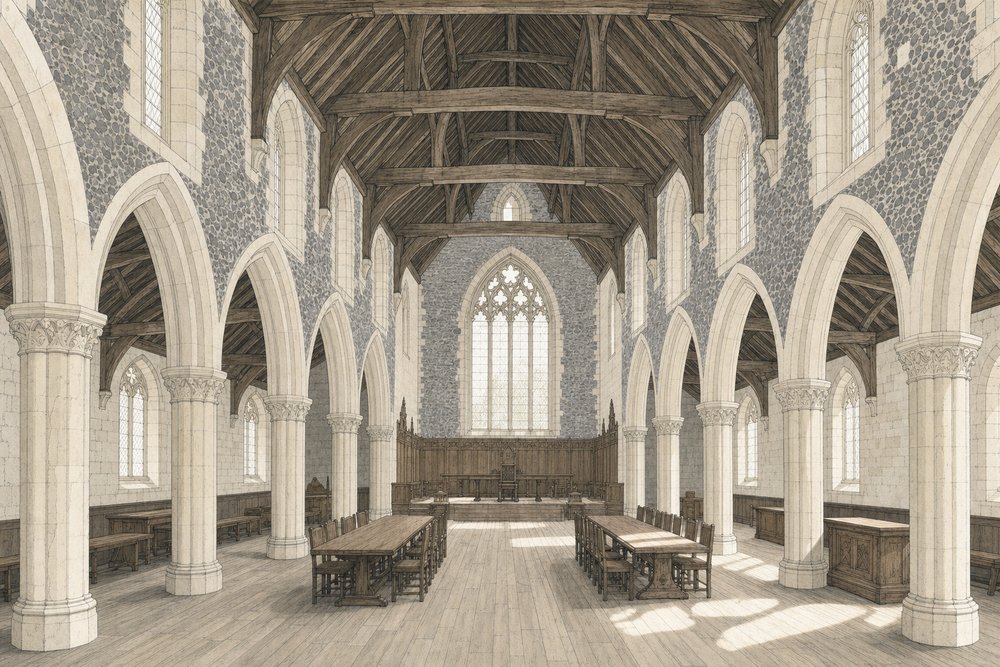
The two halls occupy the church of the Dominican friary that once filled this corner of Norwich. Together they form the most complete friary complex left standing anywhere in England, and they have been in continuous public use for close to five centuries — far longer than they ever served the order that built them.
They are simply the two halves of one building. The western room is the nave, a broad aisled space carrying an arch-braced hammerbeam roof over a sprung maple floor. Blackfriars Hall, beyond the crossing, is the former chancel: narrower, quieter, panelled in oak and lit by tall windows that taper up into the roof.
What makes the survival of St Andrews Hall Norwich remarkable is the timing. When Henry VIII dissolved the religious houses in 1538, the city corporation bought the friary outright and kept it for civic use instead of letting it be quarried for stone. That decision is the reason a fifteenth-century friary church still stands in a working city centre.
Four rooms under one roof at St Andrews Hall
The complex divides into four hireable spaces of very different character. They can be taken singly, or opened into one another for larger events that move between them. Each began as part of the same church, and the differences between them are the result of five centuries of separate decisions, never of design.
Blackfriars Hall and a room most of Norwich has stood in
For most of the twentieth century the nave doubled as Norwich’s principal concert hall. The Norwich Philharmonic Society has performed here since the Victorian period, the Norfolk and Norwich Festival has used the room throughout its modern life, and touring orchestras from the Philharmonia to the Bournemouth Symphony have taken the same platform.
The rock and pop history runs alongside it and is less often written down. The Cure played here in May 1981, Tangerine Dream on the 1975 cathedral tour, Budgie in 1982, and Rick Wakeman has returned repeatedly across four decades. The performance history collects what can be verified from the archives that keep it.
Alongside the music the building has always earned its keep as a hall in the plainest sense. Antiques and collectors’ fairs, record fairs, beer festivals, graduation ceremonies, craft markets, school prize days and civic dinners have all run under the same roof, often in the same week, and the building has never had the luxury of specialising.
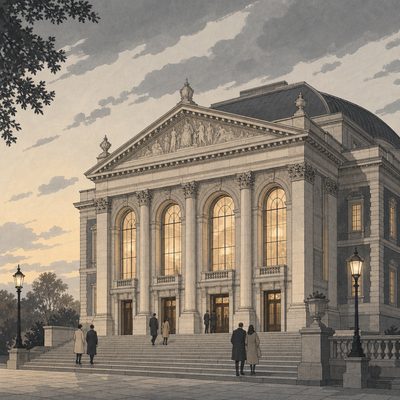
Capacities at a glance across the venue
| Room | Seated | Standing | Former use |
|---|---|---|---|
| St Andrews Hall | 750+ | 1,000 | Friary nave |
| Blackfriars Hall | 250 | 300 | Friary chancel |
| The Cloisters | 120 | 200 | Cloister walk |
| The Crypt | 60 | 80 | Undercroft |
Figures here vary with staging, catering layout and licensing, so the capacity notes set out how each room changes shape. A layout that works for a seated dinner will not hold the same number standing. Anyone comparing options across the city will also find Church halls for hire a useful reference point for smaller gatherings.
Common questions about the halls
Who runs St Andrews Hall in Norwich today?
The complex belongs to Norwich City Council, which programmes the public events and lets the rooms under the name The Halls. Enquiries about dates, catering and access go to the council’s venue team rather than to any third party, and the council publishes its own current hire terms, which is where any figure should come from.
How old are the halls, and what were they built for?
The Dominican friars finished the present church in the middle of the fifteenth century, rebuilding after a fire destroyed the earlier friary in 1413. The city bought the buildings at the dissolution in 1538 and has used them as public assembly rooms ever since, which is the reason they survived when almost every other English friary did not.
What is the difference between St Andrews Hall and Blackfriars Hall?
They are two halves of one church. St Andrews Hall is the former nave, the large open room with the hammerbeam roof, and Blackfriars Hall is the former chancel beyond it, smaller and panelled in oak. The two can be hired separately or opened up together, and most large events use both across an evening.
Can members of the public go inside?
The halls are working event rooms instead of a museum with fixed opening hours. Access normally comes through whatever is on — a concert, a fair, an exhibition or a heritage open day — and the council’s published events listing is the reliable guide to what is running in the building and when.
Where exactly are the halls?
They stand on St Andrews Plain in the centre of Norwich, postcode NR3 1AU, a few minutes north of the market place and close to Elm Hill. The site sits between St Andrews Street and Blackfriars Street, with the cloister range behind, and the nearest long-stay parking is a short walk away at the St Andrews multi-storey.
Finding the building
The halls sit on St Andrews Plain, between St Andrews Street and Blackfriars Street, a short walk north of the market place and around the corner from Elm Hill. The postcode NR3 1AU takes drivers to the right junction, though the nearest long-stay parking is at St Andrews multi-storey, not on the Plain itself.
Norwich railway station is roughly fifteen minutes on foot across Prince of Wales Road, and the bus station a similar distance to the south. Practical detail — step-free routes, loading access for exhibitors, the position of the entrances on each street frontage and where a car can actually be left — is gathered on the visiting page.