Licensed for civil ceremonies
Wedding Venues in Norwich: Civil Ceremonies and Receptions
What a wedding in a fifteenth-century friary church actually involves, from the licensed rooms to the constraints that shape the day.
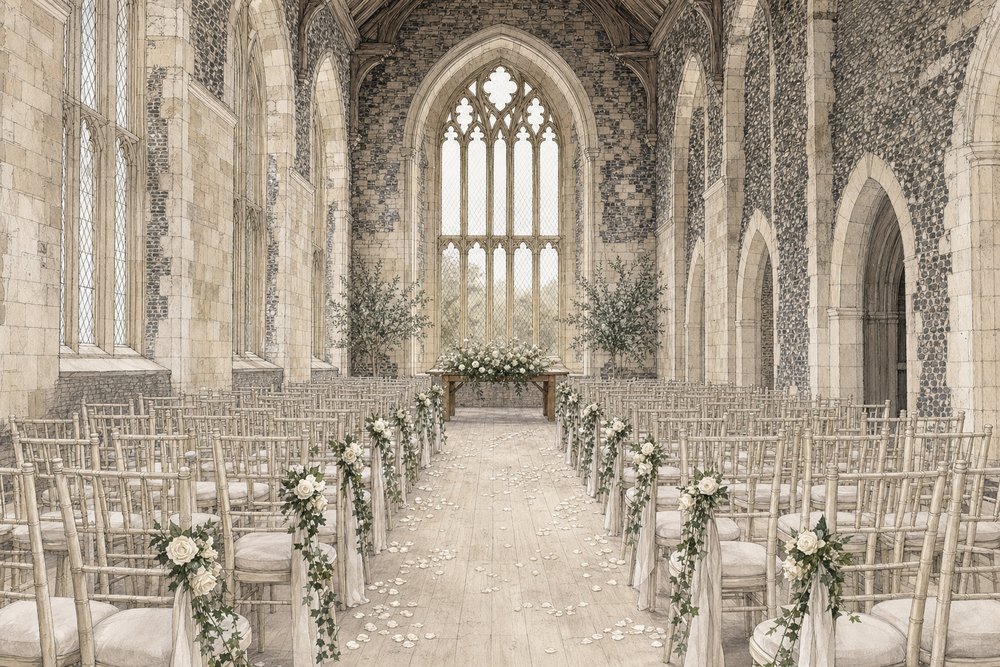
A wedding in the friary church is not a country-house wedding with older stone. The building sets its own terms, and couples who plan with those terms, early and in detail, get a great deal back from it. The building rewards a plan shaped around it and punishes one imposed on it.
The licensed rooms
Both main halls have carried licences for civil ceremonies. St Andrews Hall, the nave, gives scale — a long axial approach, arcades on either side and a hammerbeam roof overhead — and takes ceremony numbers few venues in the region can match. Blackfriars Hall offers the opposite: oak panelling, tall windows and an intimacy that suits two hundred rather than seven.
Licensing conditions are reviewed from time to time, and they apply room by room across the complex and not to the site as one. That makes confirming the current position an early task instead of a late one, because it determines which room can hold the ceremony itself as opposed to the celebration around it.
Shaping the day across the building
The complex genuinely rewards a moving event. The most common pattern puts the ceremony in one hall, drinks in the cloister walk while the first room is turned around, and dining in the other hall, with the crypt available for a smaller gathering before or after, so each part of the day gets a room proportioned for it.
That progression does something a single room cannot. Guests who walk from a vaulted undercroft into a panelled chancel and then into a hammerbeam nave experience the building rather than sit in it, and the architecture supplies most of the atmosphere that would otherwise have to be bought in and dressed on to a blank room.
What the fabric asks of you
The constraints are the ordinary ones of a listed medieval building, and they are not negotiable. Nothing fixes to the masonry. Rigging is limited and agreed in advance. Open flame is controlled. Confetti, heavy floral structures and anything that loads the historic floor need checking first. Anything meant to hang from the structure is the first item to raise.
Suppliers make or break this. A florist, stylist or band that has worked heritage venues will take the restrictions in stride; one that has not may arrive with a plan built on assumptions that do not apply here. Briefing them before they quote, not after they arrive, saves the most trouble.
Numbers and layouts
The useful figure is never the guest count alone. A hundred and fifty seated for a wedding breakfast, a hundred and fifty standing at a reception and a hundred and fifty in rows for a ceremony are three different room requirements, and part of the reason this venue works is that it supplies all three without anyone leaving the site.
Practical matters
Hire runs directly through Norwich City Council, which owns the complex and operates it as The Halls, so quotations, availability and licensing all come from one place. Catering arrangements are set by the venue and not assembled independently, and that constrains the dining layout more than most couples expect, so it is worth settling early.
Central Norwich handles guest accommodation easily. Parking is the real logistical question: the Plain itself has very little, and the visiting notes cover where cars, suppliers and coaches can actually get to. Couples weighing smaller or simpler alternatives may also find Church halls for hire a useful point of comparison for modest receptions.
Common questions
Are the halls licensed for civil wedding ceremonies?
Both main halls have been licensed for civil ceremonies, which is why the complex appears across Norfolk wedding listings. Licensing is reviewed periodically and applies room by room, so couples should confirm the current position for the space and date they want before booking anything else. The licence sits with the room, so the ceremony space settles first.
How many guests can a wedding here take?
The range is unusually wide. Blackfriars Hall suits around 250, while the nave takes over 750 seated, so the building can hold anything from a mid-sized ceremony to a very large reception. Most weddings use more than one room across the day. Moving between rooms across the day is what most couples end up choosing.
Can the ceremony and the reception be in different rooms?
That is the arrangement most couples choose, and the building is well suited to it. A ceremony in one hall, drinks in the cloister walk and dining in the other hall gives the day a natural progression, and it means each part of the event gets a room proportioned for it.
What are the restrictions on decoration?
Nothing may be fixed to historic masonry, and open flame, confetti and heavy rigging are all controlled. Florists and stylists who have not worked in a listed building before should be briefed early, because plans that assume screw fixings or free-standing pyrotechnics will need reworking. A supplier who learns the rules before quoting prices them in.
Who do wedding enquiries go to?
Norwich City Council owns and operates the complex and handles hire directly, including availability, quotations and the licensing arrangements. Enquiries go to the council's venue team, which publishes the current terms itself instead of working through third-party booking intermediaries. Terms published by the operator are the only ones that bind the booking.
Is there somewhere for guests to stay nearby?
The halls sit in the middle of Norwich, a few minutes from the market place and within walking distance of most of the central hotels, so guest accommodation is rarely the problem it can be at a rural venue. Parking rather than beds is the constraint worth planning around here, and it is worth settling early.