Dominican friary, 1226 to the present
St Andrews Hall History: The Medieval Blackfriars Friary in Norwich
How a Dominican preaching church became the assembly rooms of a city, and why it is the only English friary to have come through more or less whole.
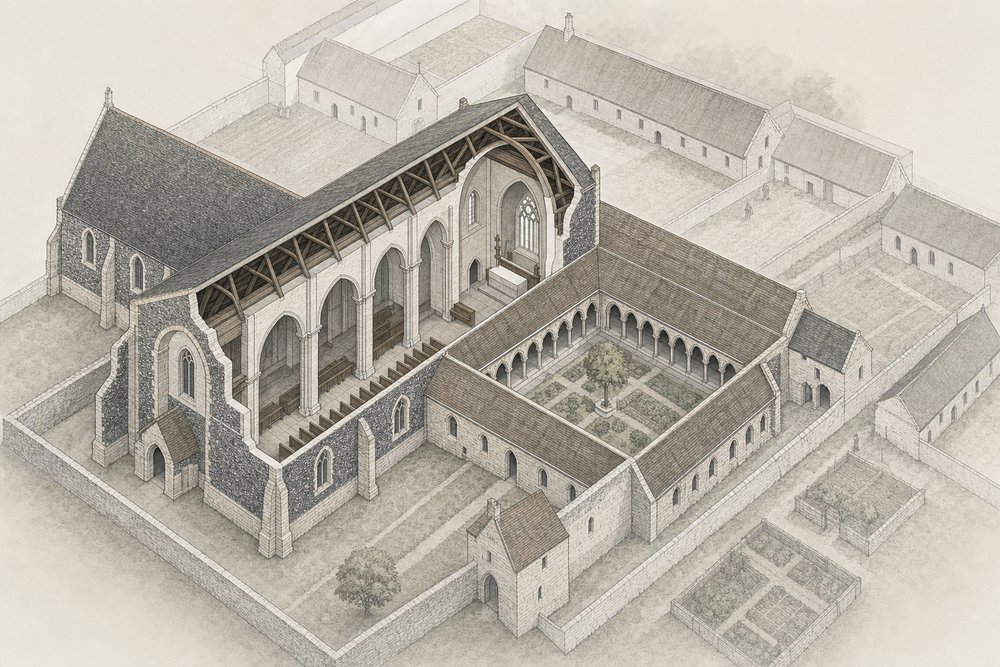
Any account of St Andrews Hall history begins with the Dominicans, who reached Norwich in 1226 and settled first on a site elsewhere in the city. They moved to the present ground in 1307, taking over buildings an earlier order had left behind, and began turning a modest precinct into the largest friary in the city.
The medieval friary and the fire of 1413
The Blackfriars friary that stands today is not that first church. In 1413 a fire ran through the precinct and destroyed the buildings the friars had spent a century assembling. The rebuilding that followed occupied much of the fifteenth century and produced the church now known as St Andrews Hall and Blackfriars Hall.
The new church was built in the Perpendicular manner then dominant in East Anglia: wide, tall, generously glazed, and arranged as one long uninterrupted volume rather than a warren of chapels. That was deliberate. Dominicans were preachers above all, and a preaching church needed a big room with clear sightlines and good acoustics, not a series of private altars.
Sir Thomas Erpingham and the Blackfriars patrons
Rebuilding on that scale needed money the friars did not have, and the work was carried by lay benefactors. Sir Thomas Erpingham, the Norfolk knight who commanded the English archers at Agincourt two years after the fire, was among them. His name still attaches to the Erpingham Gate at the cathedral and to the Erpingham Arms.
Civic families gave alongside the gentry, and the effect over time was to blur the line between the friary and the town. By the time the crown moved against the religious houses, Norwich had been paying for this church for a hundred years and had come to regard it, not unreasonably, as partly its own.
The purchase of 1538 that made St Andrews Hall civic
That sense of ownership is what saved it. When the friaries were surrendered in 1538, the usual fate was sale and demolition: lead off the roof, stone to the nearest building site, and within twenty years a field. Norwich instead bought the whole complex from the crown and set it aside for the use of the city.
The corporation’s stated intention was a common hall, and that is roughly what it has been ever since. The nave took mayoral feasts and assemblies, the chancel served for a time as a parish church and later as a meeting room, and the buildings acquired the practical, much-altered character of premises never allowed to become a monument.
Five centuries of civic use, and the history it left
The list of things the halls have housed is long and cheerfully unheroic. There have been assizes and elections, corn exchanges and charity bazaars, mayoral banquets and militia drills, a mint during one emergency and a workhouse function during another. In the nineteenth century the nave became the city’s main concert room for well over a hundred years.
That continuous occupation is the reason the medieval fabric is in the condition it is. A building that is always in use is always being repaired, and successive centuries have re-roofed, re-floored and re-glazed this one to suit themselves. Purists have complained about that since at least the Victorian period, and it is also why the church is still here.
What survives of the friary, and what does not
St Andrews Hall history is legible in the fabric itself. Above ground the church is substantially complete: the aisled nave, the crossing, the chancel beyond it, the window tracery and the arcades. The cloister walk remains to the north and is still used, and below, the crypt is the one interior that predates the fifteenth century.
The domestic ranges of the Blackfriars friary have fared worse. The dormitory, refectory and outer courts that made the precinct a working community were absorbed into the surrounding streets over the centuries, and the street pattern around Blackfriars Street now preserves their outline rather more clearly than any surviving masonry does.
What is left is the church, and the city treats it accordingly. The complex appears in the heritage grouping that brings together the city’s principal historic buildings, and the halls also hold the civic portrait collection that has hung in these rooms for generations, recording the corporation that saved the building in the first place.
Six timbers, and one absence. Pick a part to see what it does.
Common questions
Why is St Andrews Hall the only complete friary left in England?
Because Norwich bought it and not broke it. At the dissolution in 1538 most friaries were sold for their materials and vanished within a generation, but the city corporation paid for this one outright and immediately put it to civic use, which gave the fabric a reason to be maintained century after century.
What was the 1413 fire, and what did it destroy?
A fire swept the friary precinct in 1413 and gutted the church the Dominicans had been using since the 1300s. The present building is the replacement, put up over roughly the next half-century, which is why a house founded in the thirteenth century has a thoroughly fifteenth-century church above ground.
Who was Sir Thomas Erpingham and what is his connection here?
Erpingham was a Norfolk soldier and courtier, best remembered for commanding the English archers at Agincourt in 1415. He was among the lay patrons who funded the rebuilding of the friary church after the fire, and his name survives locally in the Erpingham Gate at the cathedral as well as in accounts of this site.
What does Blackfriars mean?
It is the English nickname for the Dominicans, taken from the black cappa they wore over a white habit. Franciscans were the greyfriars and Carmelites the whitefriars by the same logic, and the name attached itself to the districts where each order settled, which is why Norwich still has a Blackfriars Street.
Is the medieval structure still visible, or is it a reconstruction?
The walls, arcades, window tracery and crypt are genuinely medieval. The roof, floors and fittings have been renewed repeatedly across five hundred years of hard civic use, and the building has been restored more than once, most recently in the current programme of investment by the city council. A building in constant use is a building constantly repaired.
What happened to the rest of the friary buildings?
Less survives than of the church. The cloister walk remains and is in use, along with parts of the ranges that adjoined it, but the dormitory, refectory and outer courts have largely gone, absorbed into later street frontages as the city built up around the precinct. The street pattern around Blackfriars Street preserves their outline better than any masonry does.