Meetings and workshops
Small Room Hire in Norwich: Meeting and Workshop Rooms at The Halls
Not every booking needs a medieval nave. What the complex offers at the smaller end, and when it is the right choice.
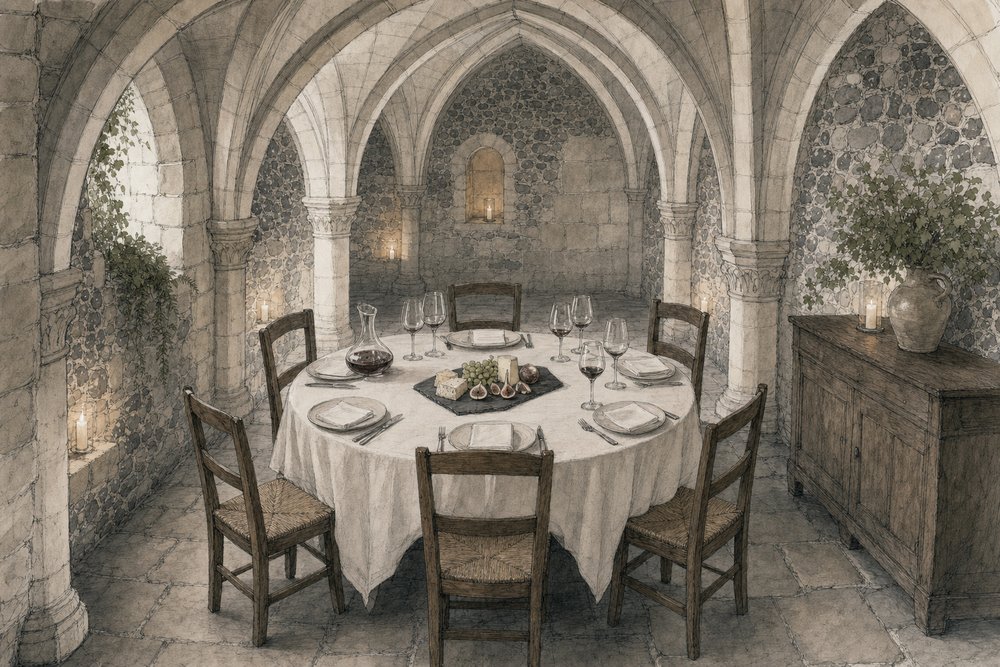
Most of what is written about this complex concerns the large rooms, which is understandable and slightly misleading. A substantial share of what actually happens here is small: committees, societies, workshops, briefings and meetings that need a decent room and not a spectacular one. Societies and committees have met in these rooms for longer than anyone has recorded.
The rooms at the smaller end
The crypt is the principal small space and the one people usually mean. A vaulted undercroft taking around sixty seated, it is the oldest interior on the site and gives a meeting a setting that no serviced office can approach. The piers reduce the usable floor, so layouts work around the structure.
Beyond it, portions of the larger rooms can be set for smaller groups, and Blackfriars Hall at around 250 is itself the small room of any event where the nave is the main one. Scale in this building is relative, and a room that feels intimate during a conference would be a main hall elsewhere.
When a small room is the right answer
The obvious case is a small gathering, but the more common one is a small room attached to a large event. Conferences need committee space and green rooms. Fairs need an organiser’s office. Concerts need somewhere for performers away from the audience. Weddings need a quiet room for a family moment.
Booking that alongside the main hire, instead of improvising it on the day, is the difference between an event that runs and one that is constantly looking for somewhere to put people. The hire guide covers how the rooms combine. A green room found on the morning is rarely the room anyone wanted.
Regular and recurring bookings
Societies, committees and community groups meeting on a repeating schedule have been part of this building’s life for centuries, and recurring hire is ordinary business for a civic venue. The practical constraint is the public programme: what can run in a small room depends partly on what is happening in the halls at the same time.
That makes availability across a series of dates the first question for a recurring booking rather than the last, and it is worth raising before a group commits to a pattern of meetings. A group that fixes a meeting pattern before checking what the halls are doing on those dates will usually have to move at least one of them.
Facilities and access
Technical provision — connectivity, display, conference facilities — was part of the recent investment in the complex and is arranged with the booking rather than sitting permanently in each room. A meeting that depends on any of it should say so at the enquiry stage. Anything the agenda genuinely relies on belongs in the booking, not in a hopeful assumption.
Access deserves specific attention at this end of the building. The crypt is below the main floor level and reached by historic steps, and while the restoration improved access across the complex considerably, a medieval undercroft sets limits that cannot entirely be designed away. Groups with mobility requirements should confirm arrangements before choosing a room.
Alternatives worth knowing
For the smallest and simplest community bookings, a fifteenth-century friary is not always the proportionate answer, and there is no reason to pretend otherwise. Anyone comparing options for a modest local gathering will find Church halls for hire a useful reference point. There is no reason to pretend otherwise, and a mismatch of that kind serves nobody.
Where this building earns its keep at the small end is when the setting is part of the purpose — a launch, a tasting, a board that wants to remember where it met, a workshop that benefits from being somewhere unlike an office. For that, the crypt has very little competition in Norwich.
Common questions
What is the smallest room available?
The crypt is the smallest of the principal spaces, taking around sixty seated and rather fewer in a layout that works around the piers. For committee-sized gatherings it is generally the room people mean when they ask about small hire in this building. Sixty people around a table is the shape most committees actually need.
Is small room hire cheaper than hiring a hall?
Rates are set by the venue and vary with the room, the duration and what the booking needs, so the position for a specific date comes from the council's own terms. As a general matter a smaller room costs less than a hall, but the servicing requirements affect it too.
Can a small room be booked for a regular meeting?
Recurring bookings are a normal part of a civic venue's business, and the building has hosted regular societies and committees for a very long time. Availability across a whole series of dates is the practical question to settle first, since public events in the main halls shape what else can run alongside them.
Is there wifi and presentation equipment?
Technical provision was part of the recent restoration and is arranged as part of the booking rather than being fixed in each room. A meeting that depends on a screen, a connection or a conference call should specify that at the enquiry stage instead of assuming it is standing by.
Are the small rooms accessible?
This varies by room and is worth checking specifically. The crypt in particular sits below the main floor level of a medieval building and is reached by historic steps, so groups with mobility requirements should confirm arrangements before choosing it over an alternative. An alternative room is usually available, and choosing it early is simpler than adapting late.
Can a small room be used alongside a larger event?
Yes, and that is one of its most common uses. Committee rooms, green rooms, press briefings, VIP receptions and quiet spaces during a conference or a fair all take a small room while the main business happens in one of the halls. Having somewhere to put people away from the main business is worth a great deal on the day.