Mayors, benefactors, civic figures
The Norwich Civic Portrait Collection at St Andrews Hall
A collection of civic portraiture built up over centuries, hanging in the hall it was assembled for.
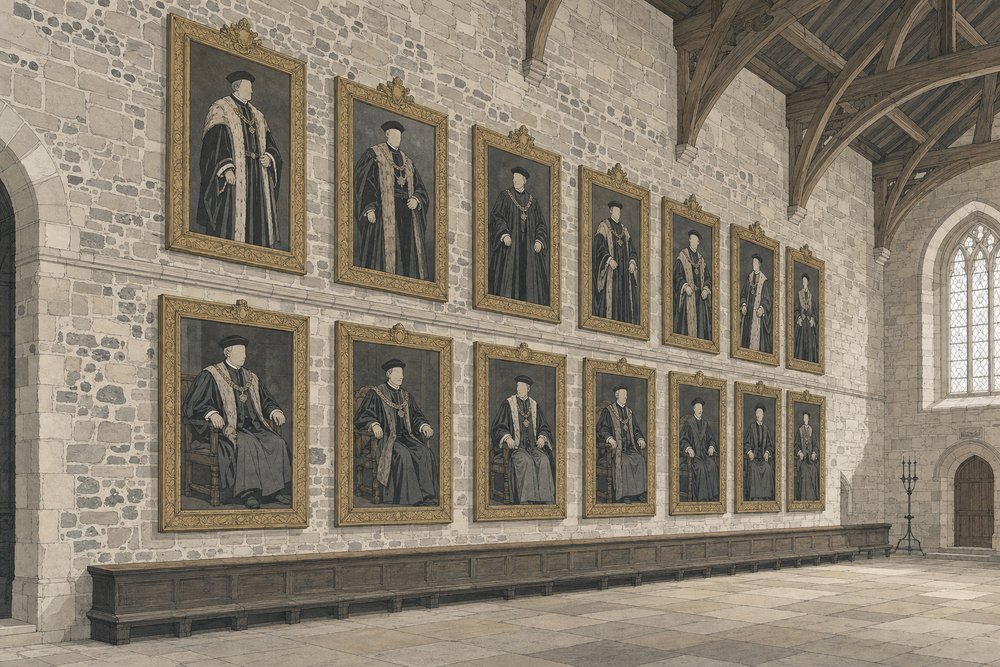
Hanging in the halls is a collection of civic portraiture built up over several centuries: mayors, sheriffs, benefactors and figures connected with the government of the city. It is one of the less obvious things about the building and one of the more revealing. Most visitors walk past it without registering what it is.
What a civic collection is
Corporations across England accumulated portraits of their own office-holders, generally by commissioning a painting when a man completed a term or by accepting one from his family afterwards. The result is not a curated collection in the museum sense but an institutional accumulation, assembled by successive administrations with no overall plan.
That produces a characteristic unevenness. Some portraits are the work of accomplished professionals working to commission; others are competent local practice; a few are neither of those things. Taken together they form a continuous visual record of who ran a city and of how each generation of them wished to be seen.
Why they hang here
Because this is where the civic body met. After the city bought the friary in 1538 the halls became the setting for assemblies, feasts and the formal business of the corporation, and portraits commissioned by that body were made to be seen in that room. The pictures and the room were, in the most literal sense, commissioned for each other.
They are, in other words, the furniture of an institution and not an exhibition. Hanging mayors where the mayors actually served is the arrangement the pictures were made for, and it is why the collection has stayed with the building instead of migrating to a gallery. The history of the complex explains how the church became a civic centre.
The Nelson connection
Nelson was a Norfolk man, born at Burnham Thorpe, and his associations run through the county’s civic and commemorative art. Material connected with him has long featured in accounts of what the building holds, which is why his name recurs in references to the collection. The county has never been shy about claiming him, and its civic art shows it.
That is characteristic of civic collections generally: alongside the office-holders sit portraits of local figures who mattered to a place for other reasons, and the national figures with a genuine local claim tend to be represented most prominently. The result is a hierarchy that says as much about local pride as about artistic merit.
Seeing the collection
The practical position is the same as for everything else on the site. This is a working event venue, not a gallery with opening hours, so viewing generally depends on the building being open for something. Heritage open days and tours are the reliable route, and the events guide explains where current listings live.
Research access is a different question. National projects cataloguing publicly owned art have documented civic holdings across the country, and those records are the practical starting point for anyone tracing a particular sitter, painter or date. Approaching the catalogue first and the building second is much the faster route. Most enquiries are settled without ever needing to enter the building.
Why it matters to the building
A venue’s identity is usually described through its architecture and its programme. The portrait collection adds a third strand: a record of the institution that saved the building in 1538 and then used it for five hundred years. The pictures record the people who decided what the building would be used for.
Without the corporation there would be no friary church left to hire out, and the pictures on the wall are the corporation looking back at what it preserved. It is a more direct connection between the medieval fabric and the modern venue than anything else standing on the site today.
Common questions
What is the Norwich Civic Portrait Collection?
A body of portraiture accumulated by the city over centuries, recording mayors, sheriffs, benefactors and figures connected with civic life. Collections of this kind were assembled by corporations across England, and Norwich's is among the more substantial survivals. Norwich kept more of its collection intact than most comparable English cities managed.
Can the portraits be seen?
They hang in a working event venue rather than a gallery, so viewing generally depends on the building being open for something. Heritage open days and tours are the reliable route, and holdings of this kind are also increasingly documented online through national art cataloguing projects. Seeing them properly usually means attending something else first.
Is there a connection to Nelson?
Nelson was a Norfolk man, born at Burnham Thorpe, and his associations with the county run through its civic and commemorative art. The collection's holdings and the building's own records have long included material connected with him, which is why his name recurs in accounts of what hangs here and in civic settings across Norfolk.
Who painted the portraits?
A mixture of hands across several centuries, ranging from accomplished professional portraitists working to commission down to competent local practitioners. That unevenness is typical of civic collections, which were assembled by successive administrations instead of acquired to a plan. Attribution for the weaker pictures is often uncertain and in some cases lost entirely.
Why are civic portraits hung in a hall and not a museum?
Because the hall is where the civic body met, and the portraits were commissioned to be seen in that setting. They are furniture of the institution rather than a curated exhibition, and hanging them where the mayors they depict actually served is the arrangement they were made for, and a gallery would strip that context away.
Are the portraits catalogued anywhere?
National projects cataloguing publicly owned art have documented civic holdings across the country, and Norwich's collection features in that broader effort. Those records are the practical starting point for anyone researching a particular sitter or painting. Those records give a sitter, a date and an attribution where one survives, which local sources often cannot.