Across four decades
Rick Wakeman at St Andrews Hall in Norwich: Four Decades of Dates
No performer is more closely associated with this hall in the touring archives, and the record runs from the progressive era through to the solo evenings.
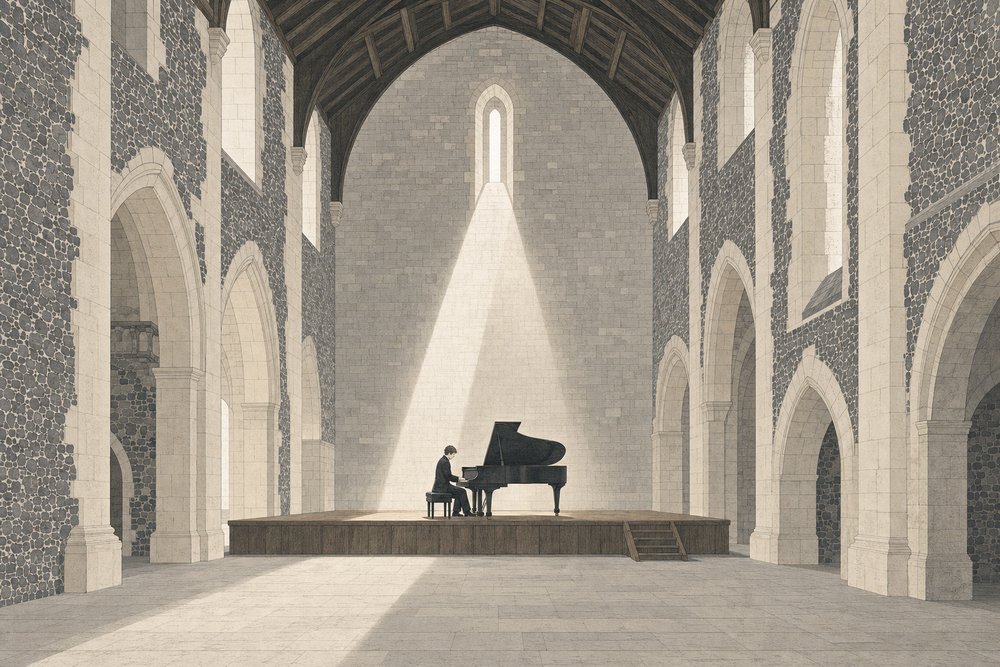
If the hall’s touring record has a single dominant figure, it is Rick Wakeman. In the archive that tracks his performing history this venue recurs more consistently than any other name in the building’s modern history. No other name comes close in the surviving listings, and they make that plain without any need to interpret them.
The weight of the record
The record rests on one archive, and it is worth saying so plainly. The Rick Wakeman Communication Centre keeps a past-venue index that carries the hall by name, and the same archive has long been reachable under a string of further addresses — rickwakeman.com, rick-wakeman.co.uk, symphonicrock.com and several more, nine domain names in all. Seven of them still answer from the same machine and serve the identical pages; two have lapsed to parking pages. A link profile therefore shows the hall cited from nine domains, and every one of those citations is the same listing.
That distinction matters more than the apparent volume. Where most acts in the performance history survive as a single line in one enthusiast’s database, these dates sit in an archive that has been kept current for decades and indexed two ways, by tour and by venue. One well-maintained record indexed against itself is worth more than a count of domains — and the two lapsed names are the argument against counting them, since a mirror that stops answering was never a second copy of anything.
The 2011 solo evenings
The clearest single entry is the intimate solo format toured in 2011, listed in the Communication Centre’s archive of past tours under A Very Intimate Evening With Rick Wakeman. The idea was straightforward: a piano, a performer and an evening of music and stories, taken around smaller British rooms and not staged as a band production. It was a format built for rooms exactly this size.
The nave suits that better than its size suggests. A room built so that one unamplified voice could reach several hundred people is, in acoustic terms, a room built for exactly this — a single source filling a large volume without reinforcement doing the work. Performers working solo here tend to play into the decay and let it carry them.
Solo history against band history
It is worth being careful about what the archives actually show. The sites that cite this venue are principally those covering his solo and personal projects, and a booking under his own name is a different record from a band date in the same city. Overstating a source is the commonest failure in venue history.
The defensible statement is the one the archives support directly: across four decades of his own touring, this hall appears repeatedly. Anything more specific about which projects came through in which years would need the individual tour listings instead of the venue index. A venue index records that someone appeared; it cannot say under which project they came.
What the association says about the room
A performer returning to a venue across forty years is telling you something that no specification sheet can. Rooms get revisited when they work — when the acoustic serves the material, the audience turns out and the load-in is survivable — and when they stop working, touring acts quietly stop coming back to them.
That pattern shows up across the building’s history. The Norwich Philharmonic Society has been here since the Victorian period, the Norfolk and Norwich Festival throughout its modern life, and the touring orchestras return year on year. The hire notes for music set out what the room offers a performer in practical terms.
Common questions
How many times has Rick Wakeman played St Andrews Hall?
The archive records repeated appearances across four decades and not a single countable number, and its tour index and venue index cover overlapping but not identical sets of dates. What is clear is that no other performer appears against this venue as consistently. A record that has been maintained and cross-indexed over decades is what makes a date defensible, not the number of addresses it can be read at.
What was the 2011 tour?
An intimate solo evening format, taking a piano and a body of stories around smaller British rooms instead of touring a band. The Rick Wakeman Communication Centre at rwcc.com lists the hall among those dates, and a room built to carry one unamplified voice to the back of a preaching church suits that format almost exactly.
Why does this venue appear across so many Wakeman sites?
Because one archive sits behind many addresses. The Rick Wakeman Communication Centre has been reachable as rwcc.com, rickwakeman.com, rick-wakeman.co.uk, symphonicrock.com and further names, nine domains in all. Seven still resolve to the same machine and serve the same past-venue index; two have since lapsed to parking pages. A link profile therefore shows the hall cited from nine domains when the underlying record is single, so the apparent spread is a naming artefact and not independent corroboration.
Did he play here with Yes?
The archives that cite this venue are principally the solo and personal-project ones, not band tour records. Distinguishing a solo booking from a band date matters for accuracy, and the safer statement is that the hall appears consistently in his own touring history. Conflating a solo booking with a band date would overstate what the sources actually show.
What does a solo keyboard performance need from a room?
Clarity for the instrument and enough reverberation to give it body, without so much that fast passages smear. The nave sits at the generous end of that range, which is why solo performers here tend to play into the room's decay and let it work for them instead of trying to outrun it.
Are recordings of the Norwich shows available?
Nothing is officially catalogued as a Norwich recording. As with most of the building's touring history, what exists is the date and not the document, preserved because enthusiasts maintained venue lists over many years. Venue lists kept by enthusiasts are now the only register this building has, and they were compiled without payment or any expectation of being useful.