26 November 1982
Budgie at St Andrews Hall in Norwich on 26 November 1982
A Welsh hard rock trio in a Norfolk friary church, preserved in an event database because somebody thought to log it.
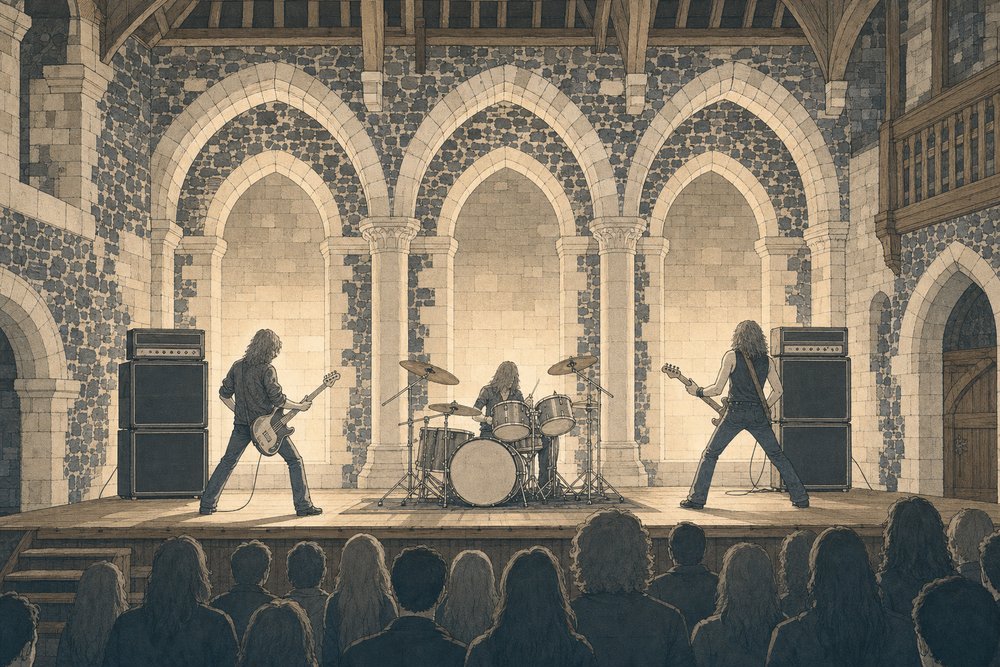
Budgie’s appearance on 26 November 1982 is a small entry in a large database, and it is exactly the kind of record that makes a building’s touring history recoverable at all. Without it, an ordinary Friday night in a Norfolk hall would have disappeared entirely. It is also, for that reason, worth dwelling on.
The record
The date survives as event 196053 in the Last.fm database, logged as Budgie at St Andrew’s Hall on Friday 26 November 1982, with the venue’s address on St Andrews Plain and the hall’s own web address as the venue reference. The entry also preserves something no other source here records: the support act was Chinatown. An entry carrying a date, a postcode and a line-up is a more precise citation than most nights of this period manage, and it is the reason the gig can be stated as fact, not as recollection.
The mechanism is worth noticing. Listeners logged concerts they had attended; the database accumulated those entries; and decades later the aggregate is a partial but genuine performance history for hundreds of venues that never kept one themselves. The performance history leans heavily on exactly this kind of source. No institution commissioned any of it, and none of it was funded.
Who Budgie were
A Welsh hard rock trio formed in Cardiff at the end of the 1960s, with a heavy riff-driven sound that proved more influential than their commercial position suggested at the time. Songs of theirs were later covered by Metallica and Iron Maiden, which is how a good many listeners first encountered the name.
They toured Britain persistently through the 1970s and into the 1980s, working the circuit of municipal halls, universities and civic rooms that carried mid-sized rock in that era. Norwich was on that circuit, and St Andrews Hall was where the circuit stopped. Bands at that level lived on the road because there was no other way to build an audience.
The hall’s early-1980s programme
The range is the striking thing. The same room that took The Cure in May 1981 took a Welsh hard rock trio eighteen months later, and in between carried orchestral concerts, civic functions and the collectors’ fairs that ran through the cloister. A booking diary of that era reads less like a policy than a series of accidents.
That mixture was not unusual for a municipal hall of the period. Cities the size of Norwich had a small number of rooms and used them for everything, which is why a fifteenth-century friary church ended up hosting both post-punk and heavy rock within the same eighteen months. Specialisation is a luxury of places with more than one venue.
The acoustic question
Loud amplified music in this room is a genuine technical challenge. The nave’s long decay, described throughout the music hire notes, will turn fast riffing into an undifferentiated wash if the engineer does not control the low end and keep the source tight. Engineers who had worked cathedrals and civic halls knew the trick; others learned it live.
Whether that particular night worked is not recorded. What can be said is that bands of this kind kept booking the room through the period, which suggests the problem was manageable for crews who understood it — and that the hall’s reputation among touring engineers was of a difficult space and not an impossible one.
Common questions
When did Budgie play St Andrews Hall?
Friday 26 November 1982. The date is preserved as event 196053 in the Last.fm database, which records the venue by name and carries the hall's own address as the venue reference, making it one of the more precisely documented nights of the building's rock period. Few nights from that period in this building are recorded as precisely.
Who were Budgie?
A Welsh hard rock trio formed in Cardiff at the end of the 1960s, known for a heavy, riff-driven sound and for songs later covered by bands including Metallica and Iron Maiden. They toured Britain persistently through the 1970s and into the 1980s, which is how they reached Norwich and a good deal of the rest of provincial Britain.
What was the hall's rock programme like in the early 1980s?
Busy and eclectic. The same room took The Cure in 1981 and Budgie the following year, which gives a fair sense of the range. Mid-sized touring acts of any genre played municipal halls in this period, and Norwich had few alternatives of comparable size. Cities of this size had few rooms and used each of them for everything.
Is there a recording or review of the night?
Nothing catalogued. As with most dates in this building's touring history, what survives is the entry rather than the evidence — a venue, a date and a band name logged in a database somewhere, with the concert itself remembered only by the few hundred people who happened to be standing in the room on the night.
Why do event databases matter for venue history?
Because no venue keeps a complete public record of half a century of touring. Databases assembled by listeners fill that gap, and for a great many buildings they are now the only surviving account of who played and when, which is a fragile basis for history but the one that exists.
Did heavy rock suit the acoustic?
It is a demanding room for loud amplified music, with a long decay that can turn fast riffing into a wash if it is not controlled. Engineers who knew reverberant halls managed it, and the fact that bands of this kind kept booking the room suggests it was workable in practice.