The 1975 cathedral tour
Tangerine Dream at St Andrews Hall on the 1975 Cathedral Tour
A tour built around the acoustics of English church buildings, and a hall that was made for precisely the sound they were chasing.
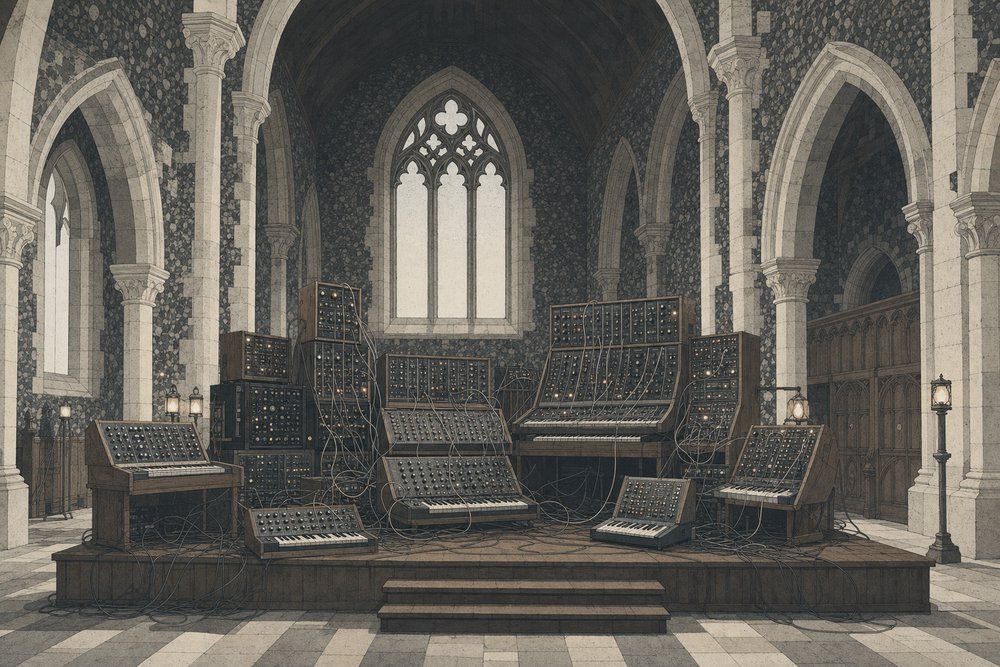
Of everything in the hall’s performance history, Tangerine Dream’s 1975 tour is the clearest case of a band choosing the building for what it does to sound. The tour was constructed around English ecclesiastical acoustics, and Norwich supplied one of the better rooms for the purpose. The room was not incidental to that tour; it was the point of it.
The idea behind the tour
By the mid-1970s Tangerine Dream were making long-form analogue sequencer music — sustained patterns evolving slowly across twenty minutes or more, improvised heavily in performance. That material does something particular in a reverberant space: the room holds each note long enough to blur into the next, and the building effectively joins the ensemble.
Conventional concert halls, designed for clarity, work against this. Churches and cathedrals, built so that an unamplified voice reaches the back, work for it. The tour followed that logic and became one of the more celebrated ideas in the band’s history, not least because playing amplified electronic music in consecrated buildings drew objections in some places.
Where the hall fits
St Andrews Hall is ecclesiastical in architecture without being ecclesiastical in function — a friary church in civic ownership since 1538 — which made it an unusually uncomplicated booking for a tour of this kind. The acoustic was right, and the permissions needed were a municipal matter rather than a diocesan one.
The room itself does exactly what the tour wanted. The nave is tall, stone-walled, and roofed in timber over a long volume, producing the generous decay described throughout the performance history. For sustained electronic sound that is close to ideal. A sequencer pattern played here returns as part of the room, not merely into it.
How the date is known
Through the band’s own community. The long-running forums at tangerinedream-music.com built an extended thread on the 1975 UK cathedral tour, running to several pages, and the posts covering it cited this hall and pointed at it as the venue reference, which is how a great deal of the building’s touring record has survived at all. That forum is intermittent now, which is the standing risk with this kind of evidence: the record outlives the archive only if somebody else has copied it down. Without those threads the date would simply have gone.
This is the recurring pattern. No official register of who played here exists; what exists instead is a distributed archive kept by people who cared enough about a particular band to write the dates down. For Tangerine Dream the keepers are unusually thorough, which is why a 1975 date in a Norfolk hall is still recoverable half a century later.
The practical reality of a 1975 electronic tour
It is worth remembering what this involved physically. The equipment of the period was heavy, temperamental and prone to drifting out of tune as it warmed, and the loading, setting and stabilising of a full analogue rig in a medieval building with restricted vehicle access was a substantial undertaking. Nothing about a 1975 electronic tour was convenient.
Those constraints have not changed much. Load-in to this site is still governed by the same narrow central-Norwich approaches described on the visiting page, and the music hire notes set out what a touring production needs to agree in advance. A modern touring production faces the same narrow approaches the band did fifty years ago.
Common questions
What was the 1975 cathedral tour?
A run of English ecclesiastical buildings that Tangerine Dream toured in the mid-1970s, choosing churches and cathedrals for their long reverberation rather than conventional concert halls. It drew a good deal of comment at the time and remains one of the more celebrated ideas in the band's long touring history.
Why choose churches for an electronic band?
Because long reverberation suits sustained electronic sound in a way that dry rooms do not. The band's music of this period was built on slowly evolving sequencer patterns and pads, and a building that holds a note for several seconds becomes part of the instrument and not an obstacle to it.
Is St Andrews Hall a cathedral?
No, and the distinction is worth making. It is a friary church, built for the Dominicans and in civic ownership since 1538, so it is ecclesiastical in architecture but not in function. Its acoustic is nonetheless exactly the kind the tour was seeking out. An unamplified voice reaching the back wall was the design brief six centuries ago.
How is the Norwich date documented?
Through the band's fan community instead of an official archive. Discussion of the 1975 tour on the long-running forums at tangerinedream-music.com cited the hall and pointed at it as the venue reference, which is how a good deal of this building's touring history has been preserved. Forum threads and tour databases are doing the work no institution ever took on.
What did the band sound like in 1975?
This was the period around Rubycon and Ricochet: long-form analogue sequencer music, largely improvised in performance, played on banks of equipment that were temperamental and enormously heavy. Concerts consisted of extended pieces, often quite unlike the studio versions. A set list in the usual sense did not exist; the running order emerged on the night.
Did the tour cause controversy?
Playing amplified electronic music in consecrated buildings drew objections in some quarters at the time, which is part of why the tour is remembered. The reaction varied a great deal by venue and by who held authority over the building in question. Some incumbents welcomed the audience; others objected to the volume and the subject alike.