Resident since the Victorian era
The Norwich Philharmonic Society at St Andrews Hall
The longest continuous musical relationship the building has, and the one that turned a civic hall into a concert hall.
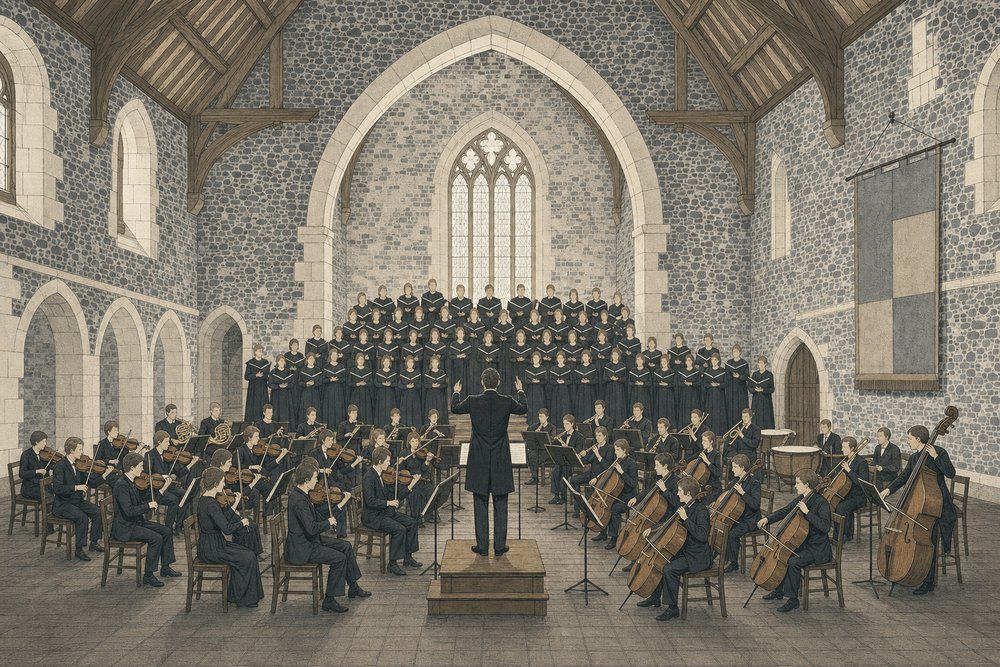
The building’s reputation as a concert hall rests more on one continuing relationship than on any number of touring nights. The Norwich Philharmonic Society has been performing here since the Victorian period, and that unbroken tradition is what turned a civic assembly room into the city’s principal concert venue rather than one more hall available for hire.
An unusually long residency
Provincial concert life in Britain is generally a story of interruption: societies fold, halls burn down or get redeveloped, wars intervene, and continuity is the exception. A performing relationship between one society and one room that has survived from the nineteenth century into the present is genuinely uncommon, and worth remarking on for that reason.
The society’s own materials treat the hall as simply where its concerts happen, which is the clearest possible indication of how settled the arrangement is. Its published concert listing names this building for its dates rather than setting out a choice of venues, and audience information, seating plans and access guidance have historically pointed people straight here instead of describing it as one option among several that a concertgoer might need to check.
What the room gives an orchestra
The fit is architectural. The nave was built so that an unamplified preacher could be heard by several hundred people in a tall stone volume, and an orchestra is solving the same problem with different equipment. The long decay flatters massed strings and gives a chorus a body that a drier hall has to manufacture.
Sightlines help as much as sound. Because the Dominicans built without screens or side chapels interrupting the space, almost every seat has a clear view of the platform, which matters more for a two-hour concert than for almost any other kind of event. Over a two-hour programme a clear view matters more than most people allow for.
The wider orchestral programme
The society is the constant, not the whole picture. The Philharmonia has appeared here for the Norfolk and Norwich Festival and for its Lutosławski centenary programme. The Bournemouth Symphony Orchestra has listed the hall among its East Anglian dates, and Britten Sinfonia has used it as a venue reference in its own concert information.
Smaller ensembles feature throughout the record. The Brook Street Band’s concert archive shows appearances from 2001, and the Chamber Orchestra of East Anglia gave the Peter Aston Memorial Concert in the hall in 2014. The University of East Anglia’s music centre programmed the room as well. Chamber groups have used the room as steadily as the full orchestras have.
Seating, staging and the practical side
Concert layouts are set per event and not fixed. Platform depth, the size of the forces and the licensing conditions for a given night all move the usable seat count, which is why the capacity notes describe the room by layout rather than quoting a single figure that would mislead for most of the programmes actually staged.
The recent restoration brought upgraded technical infrastructure and improved access across the complex, both of which matter to a society giving a full season in the room. The music hire notes set out what a performing organisation needs to settle with the venue before a concert, most of which a resident society will already have agreed once and for all.
Why the residency matters to the building
A venue that hosts touring acts is a stop on somebody else’s itinerary. A venue with a resident society is part of a city’s cultural infrastructure, and the difference shows in how the building has been treated across a century and a half of repairs, restorations and municipal budget rounds.
The history of the complex is largely a history of finding new uses for a church that stopped being a church in 1538. The concert tradition is the most durable of those uses, and the society is the reason it took hold. Nothing else the building has been asked to do has lasted anything like as long.
Common questions
How long has the society performed in the hall?
Since the Victorian period, which makes it by some distance the building's longest continuous musical relationship. The society's own materials describe the hall as where its concerts are given, and that arrangement has outlasted every other regular booking the venue has held. Very few provincial societies anywhere can claim an unbroken run of that length.
What does the society perform?
Orchestral and choral repertoire in the mainstream symphonic tradition, programmed across a season in the way amateur and semi-professional societies of long standing typically work. The scale of the forces involved is why the nave rather than any of the smaller rooms is the natural home for a season of that kind.
Does the hall have a seating plan for concerts?
Concert layouts use a seating plan that varies with the staging, and the society's own concert information has historically pointed audiences to it. Because the plan changes with platform depth and the size of the forces, it is set per concert and not fixed permanently. A plan drawn for one programme will not necessarily serve the next.
Is the hall accessible for concertgoers?
Access was a priority of the recent restoration, with step-free routes and improved facilities forming part of that work. Audience members with specific requirements have historically been directed to contact the hall directly, which remains the reliable route for a particular concert. Arrangements for a particular concert are best settled well before the day itself.
Why does an orchestra suit this room?
The nave was built to carry unamplified sound to several hundred people, which is the same problem an orchestra solves. The long decay gives massed strings and chorus a body that a dry hall cannot, and the absence of screens or chapels means sightlines to the platform are clear from almost everywhere.
Do other orchestras use the hall as well?
Regularly. The Philharmonia, the Bournemouth Symphony Orchestra, Britten Sinfonia and the Chamber Orchestra of East Anglia all appear in the hall's concert record, alongside the Norfolk and Norwich Festival, which has used the room throughout its modern existence. Between them they give the room a visiting-orchestra record that few provincial halls match.