Festival dates, 2013 and 2014
The Philharmonia Orchestra at St Andrews Hall in Norwich
A London orchestra with a long East Anglian habit, and two documented programmes in the nave.
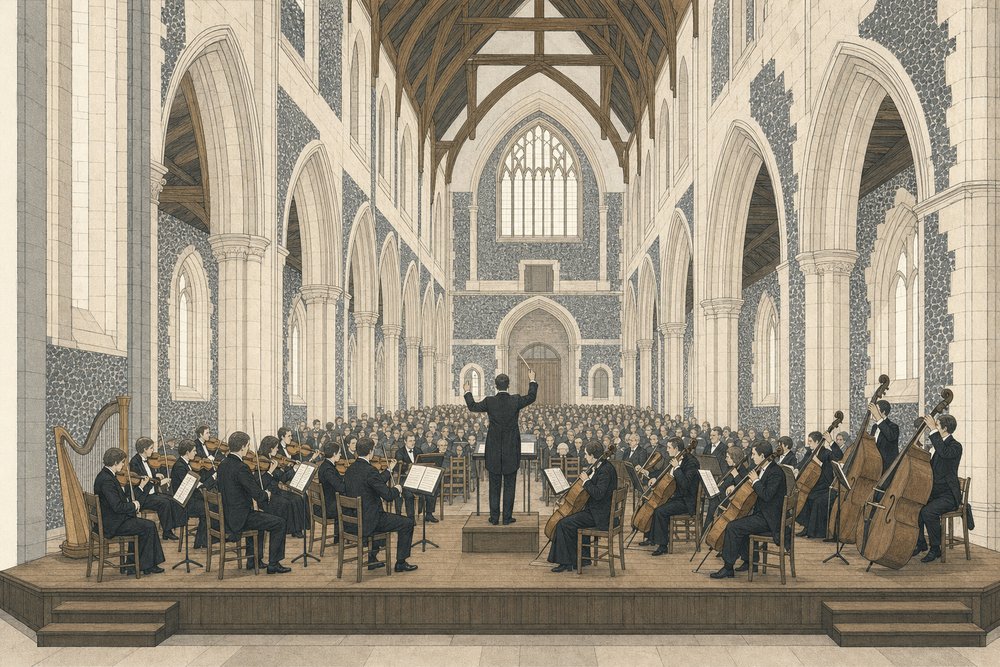
The Philharmonia’s appearances in Norwich illustrate how a provincial hall keeps company with international orchestras: not through its own programming, but through a festival that brings them in and a room that can take them when they arrive. The building supplies the room; somebody else supplies the orchestra, the audience and the money.
The 2014 festival concert
The best-documented date is 9 May 2014, a Norfolk and Norwich Festival concert. The orchestra’s own concert information lists the hall as the venue and links to it directly as the venue reference, which is the clearest form of documentation any date in the performance history has. No other date in the building’s record is attested quite that cleanly.
Festival concerts of this kind are the principal route by which major touring orchestras reach the city. The festival supplies the audience, the promotion and the programming; the building supplies a room of the right size, in the right part of the city, with an acoustic that carries a full orchestra to the back wall without any reinforcement at all.
The Lutosławski centenary
The other documented association is the 2013 centenary of Witold Lutosławski’s birth, presented under the Woven Words banner. Venue listings connected with that project include this hall, placing a substantial programme of twentieth-century repertoire in the nave. The pairing is less obvious than it looks, and more successful than it sounds.
That is worth noting because it cuts against a common assumption about historic venues. A fifteenth-century friary church is an obvious home for choral and baroque repertoire; it is less obviously a home for Lutosławski, and the fact that it served for both suggests the room is more flexible than its architecture implies.
The festival connection
The Norfolk and Norwich Festival is among the oldest city festivals in the country, with roots in the early nineteenth century, and it has used the hall throughout its modern life. For the building, the festival has functioned as a standing invitation to the international orchestral circuit, and that has shaped its musical reputation more than any single booking.
The pattern repeats with other ensembles. The Bournemouth Symphony Orchestra appears in the hall’s concert listings, Britten Sinfonia has used it as a venue reference in its own concert information, and the resident Norwich Philharmonic Society has held the room since the Victorian period. Each arrives by a slightly different route, and each leaves its trace in somebody else’s listing.
Medieval hall against modern concert hall
Musicians disagree about rooms like this one, and the disagreement is genuine rather than a matter of taste alone. A purpose-built modern hall offers controlled, predictable acoustics that let an orchestra hear itself precisely. A stone nave offers a longer, warmer decay, a room with presence, and rather less control.
For some repertoire the trade is obviously worth it; for others it obviously is not. What the record shows is that orchestras of this standing have kept accepting the trade here for a very long time, which is a practical verdict of sorts. The music hire notes set out the room’s characteristics in more detail.
Finding the detail
Historic programme information sits with the orchestras and the festival, not with the building, which is why these dates are documented through venue references in other organisations’ listings. For what the hall currently carries, the events guide is the starting point. Anyone researching a specific night should start with the performers, not the venue.
Common questions
When did the Philharmonia play St Andrews Hall?
The clearest documented date is 9 May 2014, a Norfolk and Norwich Festival concert listed in the orchestra's own concert information with the hall named as the venue. A separate Lutosławski centenary programme in 2013 also lists the hall among its venues. The orchestra links to the hall directly as its venue reference, which settles the question.
What was the Lutosławski centenary?
A 2013 programme marking the hundredth anniversary of the birth of the Polish composer Witold Lutosławski, presented under the Woven Words banner. The Philharmonia's associated venue listings for that project include this hall, which places a substantial modern-repertoire programme in the room. That places a substantial body of twentieth-century repertoire in a fifteenth-century room.
What is the Norfolk and Norwich Festival?
One of the oldest city festivals in the country, with roots going back to the early nineteenth century. It has used St Andrews Hall throughout its modern existence, and the festival is the usual route by which major touring orchestras reach the building. It remains the main route by which international orchestras reach this particular building.
Do London orchestras often play in Norwich?
Regularly, and the festival is the main mechanism. Touring orchestras need rooms of a certain size with a workable acoustic, and in this city that has meant the nave for well over a century, which is why the same handful of venue names recurs in orchestral listings for the region.
How does the hall compare with a purpose-built concert hall?
It trades precision for atmosphere. A modern hall gives an orchestra controlled, predictable acoustics; a medieval nave gives a longer, warmer decay and a room that audiences remember. Which is preferable depends on the repertoire, and both views are held strongly by musicians. Musicians hold both views strongly, and neither is obviously wrong.
Where can concert details be found?
Historic programme information sits with the orchestras and the festival, not with the building, and the venue references in those listings are how these dates are documented at all. Current programming for the hall comes from the city council's own events listing. The building itself kept no register of who performed in it.